Your website gets traffic but no clients — and the numbers look fine on paper.
Hundreds of visitors a month. Some months, over a thousand. People are finding your site, clicking through, spending time on your pages.
And yet — your inbox is empty. No consultation requests. No project inquiries. No clients.
You’ve been told traffic is the goal. Get more visitors, get more clients. So you wrote blog posts, optimized pages, maybe even ran some ads. The traffic came. The clients didn’t.
This isn’t bad luck. It’s a specific, diagnosable problem — and it has nothing to do with your writing ability, your portfolio, or how good your service actually is.
If your website gets traffic but no clients, this is a specific, solvable problem. Here’s exactly what’s happening and how to fix it.
Traffic and Trust Are Not the Same Thing
This is the misunderstanding at the root of everything.
Getting traffic means people found your website. Getting clients means people trusted your website enough to hand over money — or at least their contact information and time.
These are completely different thresholds.
Someone reading a blog post you wrote about “how to choose an SEO specialist” is curious. They’re learning. They might find the post genuinely useful. But curiosity and education don’t convert to clients. Trust does.
Trust in this context means one thing: Google showing your site to people who are actively looking for what you sell — and your site having enough authority that those people take you seriously when they find you.
Both halves of that equation have to work. Traffic without targeted intent is reading without buying. Authority without traffic is a reputation nobody sees.
Most websites that get traffic but no clients have broken one or both of these.
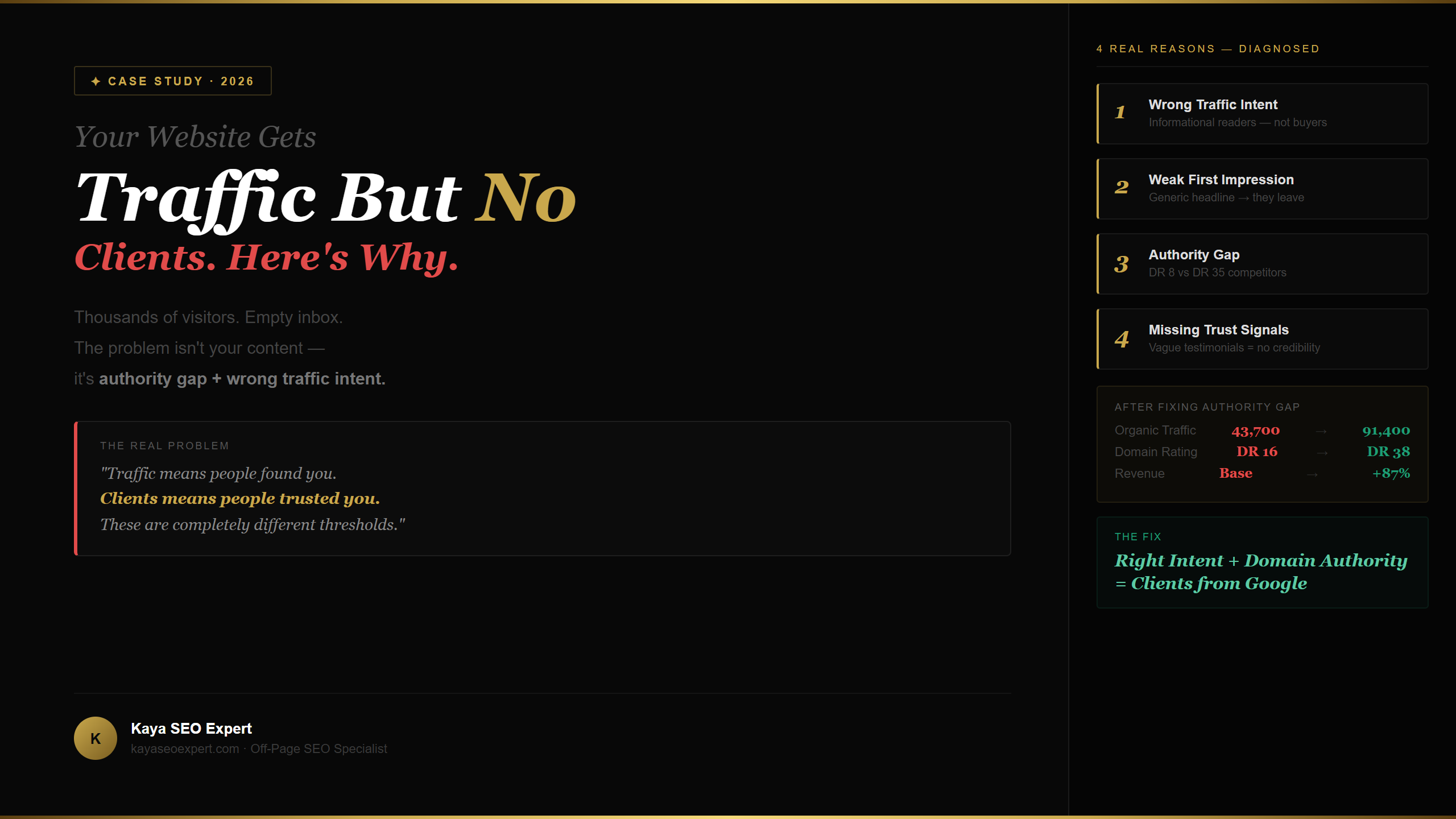
The 4 Real Reasons Your Website Gets Traffic But No Clients
Reason 1 — You’re Attracting the Wrong People
Traffic from informational keywords — “how to build backlinks,” “what is domain rating,” “link building tips” — brings people who want to learn, not buy.
If 90% of your traffic comes from educational content, you’re building an audience of people who want to do it themselves. That’s valuable for brand awareness. It doesn’t pay invoices.
The traffic that converts comes from commercial and transactional keywords — “link building service,” “hire SEO specialist,” “backlink building for ecommerce website.” These are people with intent. They’re not researching the topic. They’re looking for someone to solve it.
Check your Search Console right now. What are the top 10 queries bringing people to your site? If most of them are “how to” questions, you have a traffic intent problem.
The fix: Create dedicated service pages targeting commercial keywords. “Link building service for ecommerce” is a different page from “how ecommerce link building works.” You need both — but the first one is what pays.
This is the first reason your website gets traffic but no clients.
Reason 2 — Your Website Doesn’t Look Like the Answer to Their Problem
A potential client lands on your homepage and sees: a generic headline about “digital marketing solutions,” a list of services without specifics, some stock photos, and a contact form.
Their instinct: keep looking.
The websites that convert describe a specific problem in the first five seconds. “Your competitors are outranking you because their domain authority is higher than yours. Here’s how we fix that.” That sentence speaks directly to a person who has been frustrated by exactly this situation.
Specificity signals expertise. Expertise signals trust. Trust converts.
The fix: Rewrite your homepage headline to name the problem you solve and the specific type of client you solve it for. Not “SEO services for businesses.” Something like: “Off-page SEO and backlink building for businesses stuck on page 2.” Specificity is what separates a website gets traffic but no clients — and one that converts consistently.
Reason 3 — You Don’t Have Enough Authority to Rank for Buying-Intent Keywords
Here’s the hard truth that most traffic guides skip entirely.
Ranking for informational keywords — “how to build backlinks” — is relatively achievable even with a new website. The competition is mostly other content creators.
Ranking for commercial keywords — “link building service,” “hire SEO expert,” “backlink building agency” — is much harder. The pages competing for these terms are established service providers with DR 30-60 and years of authority signals.
Your website might get traffic from the first category but be completely invisible for the second — which means the people ready to buy never find you.
This is the authority gap. And blog posts alone don’t close it.
The full explanation of how to build this authority from scratch is here: How to Build Backlinks for a New Website in 2026
Reason 4 — Your Trust Signals Are Missing or Weak
A visitor who finds you through a commercial keyword is running a fast credibility check. They’re looking for:
- Specific results you’ve produced (numbers, percentages, timeframes)
- Evidence of real clients (testimonials with full names and company names, not “John D.”)
- A clear, direct explanation of exactly what you do and for whom
- Social proof that exists outside your own website
If any of these are missing or vague, they leave. Not because they don’t need your service — but because you haven’t given them enough to trust you over someone who has.
Wrong Traffic: The Problem Nobody Admits
Let’s be specific about intent categories because this distinction matters more than almost anything else in your content strategy.
| Keyword Type | Example | Searcher Intent | Converts to Client? |
|---|---|---|---|
| Informational | “what is link building” | Learning | Rarely |
| Navigational | “Kaya SEO Expert” | Finding you specifically | Yes — already interested |
| Commercial | “best link building service” | Comparing options | Often |
| Transactional | “hire link building specialist” | Ready to buy | Most frequently |
Most content-driven websites are generating almost entirely informational traffic. The pages that generate commercial and transactional traffic require different optimization — and different authority levels to rank.
For e-commerce businesses specifically, this problem is acute: enormous amounts of traffic to blog content, almost nothing reaching category and product pages where purchases happen. The solution for e-commerce is covered in detail here: Ecommerce Link Building Guide 2026
The Authority Gap: Why Google Sends Buyers to Your Competitors
This is exactly why your website gets traffic but no clients — the authority gap is sending buyers to your competitors. Imagine two SEO specialists. Both have websites. Both have service pages targeting “link building for local business.”
Specialist A: website DR 8, 12 referring domains, published 6 months ago. Specialist B: website DR 35, 67 referring domains, published 3 years ago.
Specialist A’s content might actually be better. Their process might be more sophisticated. Their results might be stronger.
Google doesn’t know that. Google knows that 67 websites have linked to Specialist B’s site as a reference, and 12 have linked to Specialist A’s. In the absence of other distinguishing information, Google sends the buyers to Specialist B.
This is why your traffic is coming from keywords where you have no competition — and the keywords that would bring clients are sending people elsewhere.
The fix isn’t writing more content. It’s building the domain authority that lets your content compete for the searches that matter.
For local businesses, this authority gap is even more directly tied to revenue. A business ranking position 11 on Google Maps versus position 3 isn’t a minor difference — it’s the difference between being found and being invisible. The mechanism behind local authority is explained here: Link Building for Local Business in 2026 and How to Rank on Google Maps for Local Business
Your Google Business Profile Is Part of the Same Problem
The same authority gap that hides your website from buyers also affects your visibility on Google Maps. A business with weak domain authority and few referring domains doesn’t just rank poorly in organic search — it struggles to appear in the local 3-pack where high-intent customers are actively looking for services nearby. If your site is invisible in search results, there’s a good chance your Google Business Profile is underperforming too. Understanding how Google Places ranking works — and what signals actually move the needle — is the missing piece for businesses that rely on local clients.
Real Numbers: What Happens When You Fix Both Problems
A case study from an e-commerce client that had a website gets traffic but no clients illustrates what the combined fix looks like.
Starting point: consistent traffic, almost no organic client acquisition. Product pages weren’t ranking for buying-intent keywords. The homepage was accumulating authority but it wasn’t reaching the pages that needed it.
The intervention had two parts:
- Redirect link building from homepage to category pages — the pages that actually rank for buying keywords
- Build domain authority through niche-relevant referring domains at a consistent velocity
Results over 90 days:
| Metric | Before | After |
|---|---|---|
| Domain Rating | 16 | 38 |
| Monthly organic clicks | 43,700 | 91,400 |
| Keywords in top 10 | 14 | 52 |
| Revenue from organic | baseline | +87% |
The traffic was already there in the early stages. The clients came when the authority caught up with the intent of the traffic.
Full breakdown of this campaign: How I Doubled an E-Commerce Store’s Traffic in 3 Months
If your website gets traffic but no clients, the steps below address both root causes directly.
The Fix: A Prioritized Action Plan
Every website gets traffic but no clients for one of two reasons: a traffic intent problem, an authority problem, or both. Here’s the sequence that addresses the root causes:
If your website gets traffic but no clients, here’s the sequence that addresses the root causes:
Step 1 — Audit your traffic intent (This week) Open Search Console. List your top 20 queries by impressions. Classify each as informational, commercial, or transactional. If less than 20% are commercial or transactional, you have an intent problem.
Step 2 — Create or improve your commercial pages (Next 2 weeks) Your service pages need to target commercial keywords, describe a specific problem, and address the trust signals buyers are looking for. One well-optimized service page targeting “link building for [your niche]” is worth more than twenty blog posts.
Step 3 — Check your authority gap (This week) Use Ahrefs free tool or Semrush to check the Domain Rating of pages ranking in positions 1-5 for your target commercial keywords. That’s your authority target. If you’re at DR 8 and they’re at DR 35-45, no amount of content optimization closes that gap.
Step 4 — Start building authority toward your commercial pages (Month 2 onwards) This means backlinks — specifically, backlinks from topically relevant sites pointing to your service pages, not just your homepage. The velocity that works without triggering filters: 8-12 new referring domains per month, consistently.
Step 5 — Add social proof that works (Next 2 weeks) Replace vague testimonials with specific ones. “They improved our rankings” is forgettable. “Domain Rating went from 12 to 31 in 4 months, organic leads increased by 340%” is credible.
The CTA That Changes Everything
You’ve read this far because one of two things is true.
Either your website gets traffic but no clients — and you’re trying to figure out what to do about it.
Or you work with clients who have this problem and you’re building your understanding of why it happens.
If it’s the first: the diagnosis in this article points to one of two root causes. Either your traffic is the wrong kind — informational instead of commercial — or your site doesn’t have the authority to rank for the searches that bring buyers. Usually it’s both.
Fixing the content side takes weeks. Fixing the authority side takes months of consistent work.
If you want to skip the trial and error: I build the off-page authority — the backlink profiles — that close this gap for businesses and service providers. Not packages. Not bulk links. A specific strategy built around your niche, your current authority level, and the keywords your buyers are actually using.
The results look like what’s documented in this article: measurable DR improvement, rankings for commercial keywords, organic traffic that includes people who want to buy.
If that’s what you need, the conversation starts at kayaseoexpert.com.
Tell me where your site is now — DR, current traffic, the keywords you want to rank for — and I’ll tell you exactly what closing the gap looks like for your specific situation.
No pitch. Just a clear picture of what’s possible and what it takes to get there.