Most link building tactics follow a predictable arc: someone writes about them, everyone starts using them, inboxes get flooded with templates, response rates crater, and within a couple of years the tactic is either dead or marginally effective at best.
Broken link building has been known and written about since at least 2012. It’s been featured in virtually every “advanced link building” guide published in the past decade. And it still works — often better than tactics that were considered cutting-edge just two or three years ago.
The reason has nothing to do with SEO loopholes or algorithm blind spots. It works because the underlying mechanic is fundamentally different from almost every other link building approach: instead of asking someone for something, you’re doing them a favor. You’re telling them their page has an error — a dead link that makes their content worse for the readers they care about. The fact that you have a suggested replacement is almost incidental to the initial value you’ve delivered.
This broken link building guide walks through the complete process — how to find broken link opportunities, how to build or identify content that qualifies as a genuine replacement, how to write outreach that gets responses, and what realistic expectations look like when running this as an ongoing system rather than a one-time campaign.
If you’re newer to link building and want to understand where broken link building fits within a broader strategy, this foundational guide to building backlinks for a new website provides the context that makes everything in this guide more actionable.
What Is Broken Link Building?
The mechanism is straightforward:
- Find a page on another website that contains a link to a URL that returns a 404 error — meaning the destination no longer exists
- Identify or create content on your own site that covers the same topic as the original, now-dead destination
- Contact the website owner, alert them to the broken link, and suggest your content as a replacement
The reason this creates a real exchange rather than a pure ask is that broken links are genuine problems for website owners. A resource page with dead links reflects poorly on the site’s maintenance quality. A blog post that links to a 404 damages the reader experience. These aren’t abstract SEO concerns — they’re real issues that any conscientious website owner would want to fix if they knew about them.
When you bring that problem to their attention — before mentioning your replacement at all — you’ve already provided value. The request that follows sits in a fundamentally different context than a cold pitch asking for a guest post slot.
Why Broken Link Building Outperforms Guest Post Outreach
This comparison matters practically because both tactics require outreach effort, and understanding the difference helps you allocate that effort effectively.
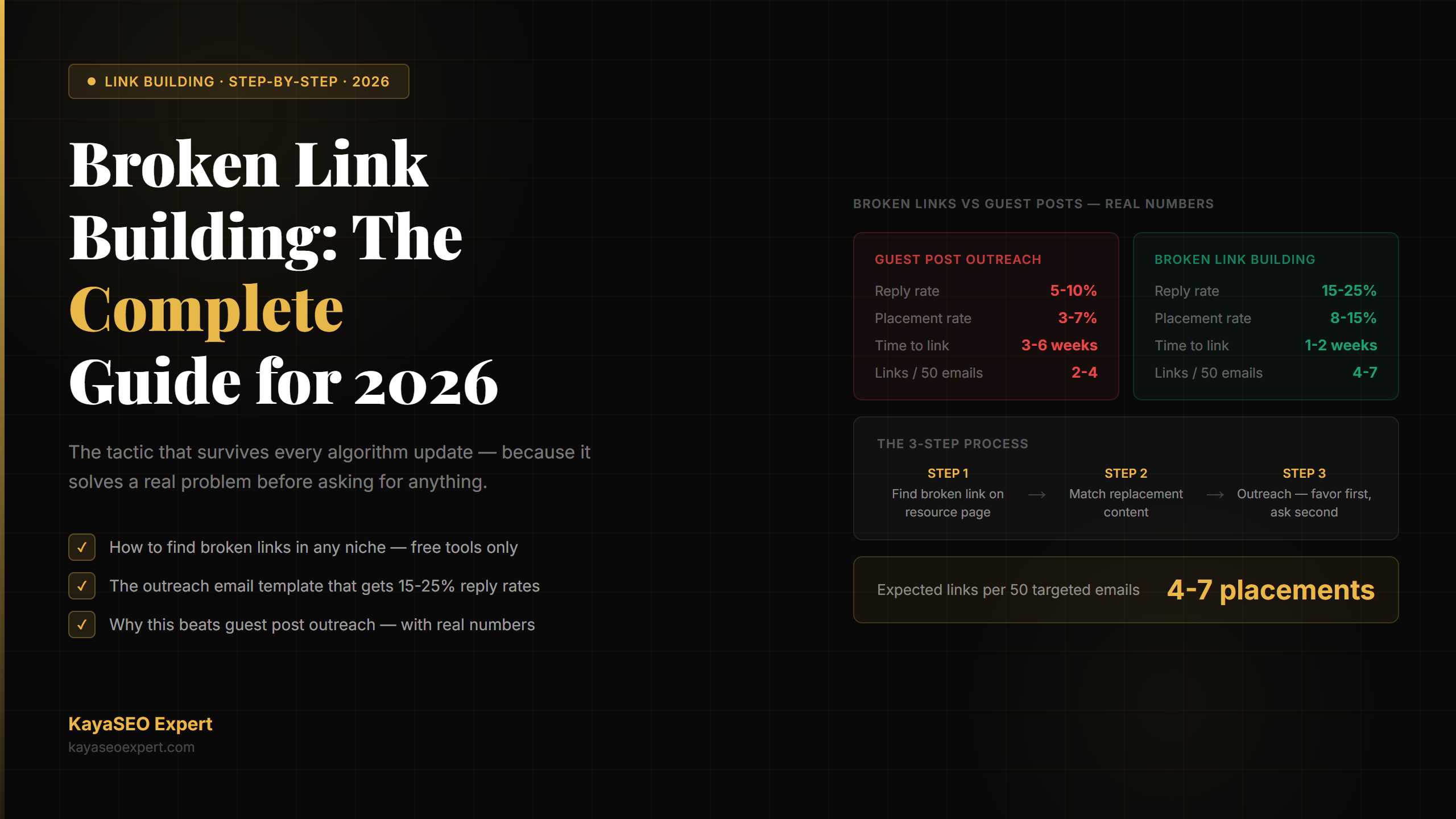
Guest post outreach, in 2026, typically sees:
- Response rates: 5-10%
- Placement rates: 3-7% of total emails sent
- Average time to placement: 3-6 weeks
- Typical cost: editor review time + content creation
Broken link outreach, run with personalized, targeted emails:
- Response rates: 15-25%
- Placement rates: 8-15% of total emails sent
- Average time to placement: 1-2 weeks
- Typical cost: research time + content creation (same as guest posts)
The difference in response rates — roughly 2-3x better — compounds significantly at scale. If you send 100 emails using each approach with comparable effort, broken link outreach produces roughly 8-15 actual placements versus 3-7 from guest post pitching. Same effort, substantially more results.
The quality difference also works in broken link building’s favor. The sites you’re targeting are ones that have already demonstrated they link out to external content on the topic you’re targeting — which is a meaningful pre-qualification that guest post prospecting doesn’t offer.
How to Find Broken Link Opportunities
Broken link building opportunities come in three main forms, ranging from free-and-manual to systematic-and-scalable.
Method 1 — Browser Extension Scanning
The fastest way to start is with a free browser extension like “Check My Links” (Chrome) or “LinkChecker” (Firefox). These tools scan every link on a page in seconds and highlight broken ones in red.
The workflow:
- Search Google for resource pages in your niche: your topic + “useful resources”, your topic + “recommended tools”, your topic + intitle:”resources”
- Open each resource page
- Run the extension
- Note any broken links and what they used to cover (more on this below)
This method is manual but costs nothing and can surface opportunities quickly. A session of an hour or two, covering 15-20 resource pages in your niche, will typically surface multiple broken link opportunities if the pages haven’t been recently audited.
Method 2 — Wayback Machine Research
Once you’ve identified a broken link, the next step before doing anything else is checking what that link used to contain. Navigate to web.archive.org, paste the broken URL, and look at the most recent archived version.
This matters enormously for the relevance of your pitch. If the broken link used to point to “10 Strategies for Building Local Business Citations,” your outreach should reference a page that covers similar ground — not a generic service page or homepage. The more specific the match between what the dead link covered and what your replacement covers, the more natural and convincing the suggestion.
This also helps you identify content gaps. If you consistently find broken links in your niche pointing to topics you haven’t covered, those topics are telling you something: they attracted enough links to warrant someone building a resource page that linked to them. That’s a meaningful content signal.
Method 3 — Competitor Backlink Analysis
This approach scales broken link building systematically. Using a tool like Ahrefs’ free backlink checker or Semrush, look at the backlink profiles of established sites in your niche. Filter for links pointing to 404 pages — these are broken inbound links that the site owner may not even know about.
For each broken link you find this way, you’ve discovered two things simultaneously: a page that has already earned external links (meaning it covered something people considered linkworthy), and a resource page or referring domain that’s linking to a dead URL (meaning they’re a potential outreach target for your replacement).
This method is particularly powerful for ecommerce sites, where competitors frequently redesign their sites, change URL structures, or discontinue products and categories — creating broken links in the process. The ecommerce link building guide covers how to use competitor analysis specifically in ecommerce contexts, and broken link prospecting via competitor backlink analysis is one of the most reliable sources of opportunities in that space.
How to Build Replacement Content That Actually Gets the Link
Finding a broken link opportunity is only useful if you have something genuinely worth linking to as a replacement. This is where a lot of broken link outreach fails — not in the outreach itself, but in the quality mismatch between what the broken link used to offer and what the suggested replacement actually delivers.
Match topic depth, not just topic. If the broken link pointed to a 2,000-word comprehensive guide on local citation building, and your replacement is a 400-word overview blog post, the site owner is unlikely to see it as a genuine equivalent — and they’d be right not to This is why successful broken link building depends as much on content quality as it does on outreach. Your replacement content needs to deliver at least comparable value to what the dead resource used to offer.
Match format where possible. If the broken link pointed to a checklist, a checklist replacement will land better than a narrative article. If it pointed to a “best tools” roundup, a similar roundup will feel more natural than a how-to guide.
Update what’s outdated. One significant advantage you have over the dead resource is recency. If the broken link pointed to content from 2021 that’s now outdated, your replacement can explicitly be the 2026 version — which is a genuine reason for the site owner to prefer your content over whatever the original was, even aside from the fact that the original is dead.
Sometimes you’ll find a broken link opportunity and already have a page that’s a near-perfect match. More often, you’ll need to either create new content or substantially update an existing page to serve as a genuine replacement. The extra work is almost always worth it — content created with a specific broken link opportunity in mind tends to be more topically precise than content created without a defined use case.
The Outreach Email That Gets Responses
The structure of your outreach email matters as much as the fact that you sent one. Here’s what consistently works:
Lead entirely with the notification.
Most people write outreach that spends two sentences on pleasantries, then immediately gets to “I have this great content you should link to.” This fails because it signals that the real purpose is self-promotion before you’ve established any reason for the recipient to care.
Effective broken link outreach leads with the favor — the notification — and makes the replacement suggestion feel almost incidental, which is the correct framing given that you’ve already delivered value before asking for anything.
Template that consistently performs:
Subject: Broken link on [page title]
Hi [Name],
I was reading through your [page title / topic] page and noticed that one of the links — [description of the link, e.g., “the link to [anchor text]”] — is returning a 404. It looks like the original resource at [broken URL] is no longer active.
Thought you’d want to know, since it’s probably a quick fix.
If it’s useful, I actually have a resource covering similar ground — [brief description of your content]. Happy to share the link if you think it’d be a good fit as a replacement, but no worries at all if not. Just wanted to flag the broken link regardless.
Thanks for maintaining such a useful resource page.
[Your name] [Your website]
Notice several things about this template: the subject line is purely factual (broken link = useful alert, not spam), the opening two sentences are entirely about the favor before anything is asked, the suggestion is framed as optional (“no worries if not”), and the closing restates that the notification was the primary purpose.
For local businesses and local resource pages:
A slight variation works particularly well for community or local resource pages — chamber of commerce sites, local business directories maintained by bloggers, local association resource lists. For these, mentioning that you’re a local business in your opening sentence adds a layer of community context that can meaningfully increase response rates.
This is one of the most underused angles in local link building. The guide to local business link building covers local resource page outreach in more detail, but broken link building specifically on local resource pages often sees higher response rates than general broken link outreach, because the community element creates a sense of mutual interest.
Realistic Success Rates and What to Expect
Honest numbers matter here because inflated expectations lead people to abandon approaches that are actually working.
A well-run broken link building campaign, using personalized outreach (not mail-merge templates) to genuinely relevant pages, should see:
| Metric | Realistic Range |
|---|---|
| Reply rate | 15-25% |
| Link placement rate | 8-15% of emails sent |
| Average time to placement | 1-2 weeks from email |
| Links per 50 emails sent | 4-7 placements |
These numbers mean that if you send 50 carefully targeted, personalized emails over the course of a month, you should expect somewhere between 4 and 7 actual link placements. That’s meaningful link building progress — and the links you get this way tend to be from actively maintained pages, by definition, since the owner just edited the page to fix the broken link you reported.
The compounding effect over time is where this becomes particularly powerful. Sites that have once responded positively to a broken link notification from you are often receptive to future outreach — the relationship has been established on a favorable note. Building a list of responsive website owners in your niche, and checking their pages periodically for new broken links, is one of the more efficient ongoing link building systems available.
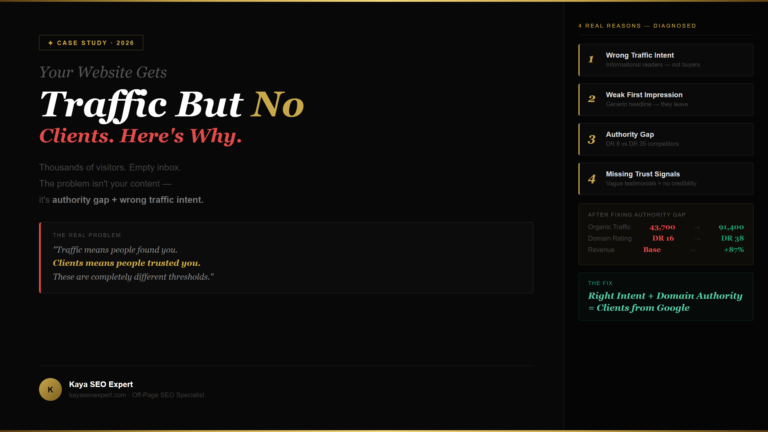
If you’re currently in a situation where your site gets organic visits but those visits aren’t translating into client inquiries or sales, the issue often isn’t visibility — it’s what happens after someone arrives. This piece on why websites get traffic but no clients addresses that specific dynamic, which is worth reading alongside a link building effort to make sure the backlinks you’re earning are supporting pages that can actually convert.
5 Mistakes That Kill Broken Link Building Results
Mistake 1 — Skipping the Wayback Machine step. Without knowing what the broken link used to cover, your replacement suggestion is a guess. Even if the anchor text gives you a rough idea, the actual archived content often reveals a much more specific topic — and that specificity determines how relevant your replacement will feel.
Mistake 2 — Sending the same email template to everyone. Recipients of broken link outreach are often experienced website owners who recognize templates immediately. Personalizing even one or two details — the specific page you found the link on, what the broken resource used to cover — dramatically increases perceived authenticity and response likelihood.
Mistake 3 — Suggesting a replacement that doesn’t match. A partial-match replacement is worse than no suggestion at all, because it makes you look like you’re just trying to get a link rather than genuinely trying to help. If your content doesn’t closely match what the dead link covered, either pass on that opportunity or create the matching content first.
Mistake 4 — Only targeting resource pages. Resource pages are the easiest and most common target for broken link building, but they’re also the most picked-over. Blog posts, guide pages, and editorial content also contain broken links — often ones that nobody has noticed or reported yet. Expanding beyond resource pages surfaces opportunities that have less competition.
Mistake 5 — Not running a local SEO audit before doing outreach. If your site has technical issues — slow page speed, broken pages, poor mobile experience — sending outreach and getting website owners to your pages is counterproductive. Make sure your destination pages are in good shape before driving traffic to them. Running a local SEO audit catches exactly these kinds of issues before your outreach campaign reveals them to potential link partners at the worst possible moment.
Your Broken Link Building Campaign Checklist
Use this for each outreach campaign:
Research Phase
Identify 20-30 target resource pages in your niche
Run broken link checker on each page
Use Wayback Machine on every broken URL found
Document: broken URL, what it used to cover, page it appears on, site owner contact
Content Phase
For each broken link opportunity, identify your best matching existing page
If no match exists, create or update content to match the broken resource’s topic and depth
Ensure replacement page is fully functional (no technical issues, mobile-friendly, fast loading)
Outreach Phase
Personalize each email — reference specific page and specific broken link
Lead with notification, not replacement suggestion
Send follow-up after 5-7 days if no reply
Track responses and link placements in a simple spreadsheet
Ongoing
Re-check target resource pages every 90 days for new broken links
Build a list of responsive website owners for future outreach
Expand to blog posts and editorial content, not just resource pages
The Bottom Line
Broken link building works in 2026 for the same reason it worked in 2015: it solves a real problem for the person you’re reaching out to, independent of your SEO goals. That alignment between your interest and theirs is what makes this tactic durable — and what explains why it consistently outperforms approaches that ask for something without offering anything first.
If you’re running this process and want help identifying the highest-value resource pages in your specific niche, auditing your existing link profile for quality, or building out the content that makes your replacement suggestions genuinely compelling — that’s exactly the work I help clients with. You can learn more and reach out at kayaseoexpert.com. And if you’ve wondered about the difference between building links this way versus buying link packages from marketplace sellers, this comparison addresses that directly.