Ecommerce link building is the single most important factor
determining whether your online store ranks on page one or disappears on page three.
Your store has good products. Your website looks professional. You’ve optimized your titles and descriptions. But when you search for your main keywords on Google, your competitors keep appearing above you — stores that, in some cases, have worse products and a weaker website than yours.
The reason is almost never your content. It’s almost never your design. It’s one number: Domain Rating. And the gap between your DR and your competitor’s DR is the gap between page three and page one.
This guide covers everything you need to know about ecommerce link building in 2026 — strategies built specifically for online stores, not blogs or service sites.
Why Ecommerce Link Building Is Different
Link building for an ecommerce store is not the same as link building for a blog or a service website. The difference comes down to what Google is being asked to rank.
When someone searches “best running shoes for flat feet,” Google isn’t just evaluating content quality. It’s evaluating commercial trustworthiness. Is this store legitimate? Do real people reference it? Do authoritative websites in the fitness or retail space link to it?
Google applies a higher trust threshold to ecommerce sites than to informational content — because ecommerce pages ask users to hand over their credit card details. A store with no external authority signals gets filtered out of competitive results regardless of how well-optimized its product pages are.
This creates a specific challenge: the keywords ecommerce stores need to rank for — product category terms, commercial queries, buying intent searches — are exactly the keywords where Google requires the most authority before it ranks you.
The solution is not more content. It’s more authority. And authority comes from backlinks.
The 4 Most Effective Backlink Types for Ecommerce Stores
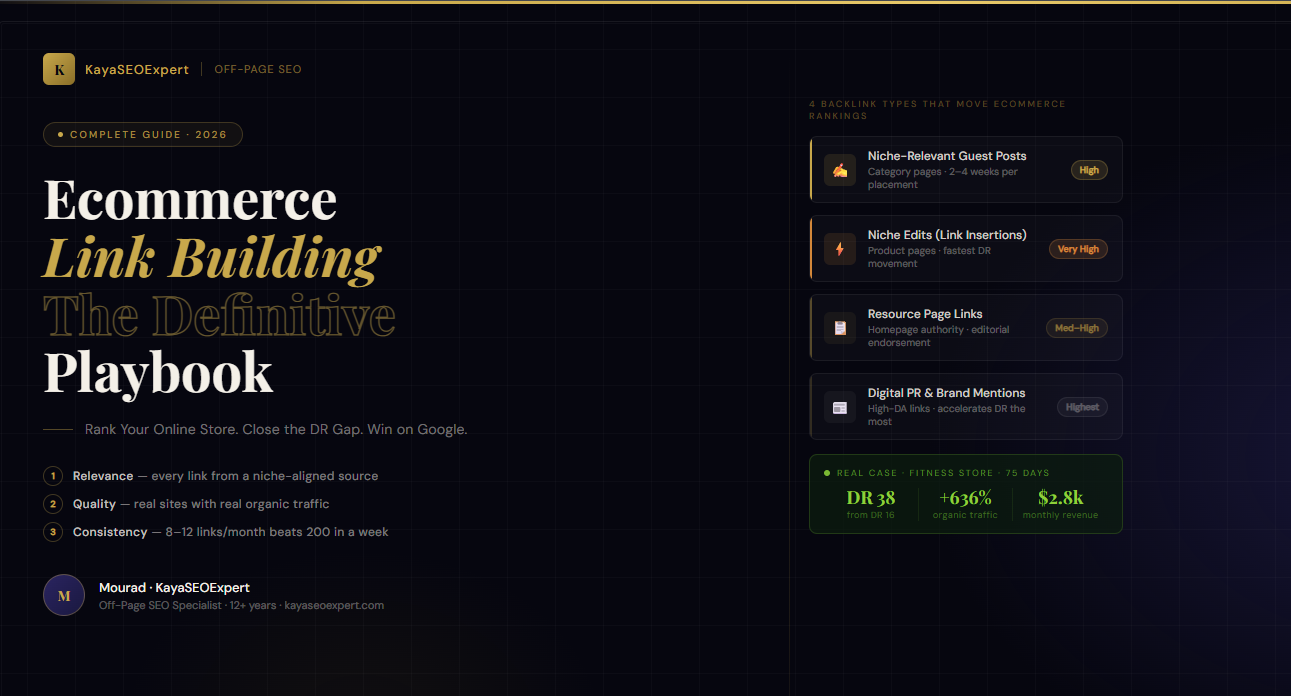
Not all backlinks work equally well for online stores. Based on what consistently moves rankings for ecommerce sites in 2026, these four types deliver the strongest results:
1. Niche-Relevant Guest Posts
A guest post is an article you write — or have written — for another website in your niche, which includes a link back to your store. The key word is niche-relevant.
A link from a fashion blog pointing to a clothing store carries 10x more weight than the same DA link from an unrelated technology site. Google’s algorithm evaluates topical context, not just raw authority.
Best for: Building authority to category pages and homepage Timeline: 2–4 weeks per placement Authority transfer: High
2. Niche Edits (Link Insertions)
A niche edit involves placing your link inside an existing, already-indexed article on a relevant website. Because the article already has traffic and Google trust, the link carries authority immediately — often faster than a new guest post.
Best for: Product pages and high-converting landing pages Timeline: 1–2 weeks per placement Authority transfer: Very high — fastest DR movement of any method
3. Resource Page Links
Many websites in every niche maintain “best resources” or “recommended tools” pages. Getting listed on a resource page in your industry delivers a clean, editorial link that Google treats as a genuine endorsement.
Best for: Homepage and brand authority Timeline: 2–6 weeks (requires outreach) Authority transfer: Medium-high
4. Digital PR and Brand Mentions
Digital PR involves creating something genuinely noteworthy — original research, a useful tool, a compelling data study — that earns coverage and links from industry publications and news sites.
Best for: Building high-DA links that move DR significantly Timeline: 4–8 weeks Authority transfer: Highest of all methods
| Backlink Type | Speed | Authority | Best For |
|---|---|---|---|
| Guest Posts | Medium | High | Category pages |
| Niche Edits | Fast | Very High | Product pages |
| Resource Pages | Slow | Medium-High | Homepage |
| Digital PR | Slow | Highest | DR acceleration |
Which Pages on Your Store Need Backlinks First
This is where most ecommerce store owners make a critical mistake: they build links to their homepage and ignore everything else.
Your homepage matters. But in most cases, your category pages are the highest-value pages on your entire store — and they’re the pages that need backlinks most urgently.
Priority 1 — Category Pages
Category pages rank for broad, high-volume commercial terms. “Men’s running shoes.” “Wireless headphones under $100.” “Organic skincare products.” These are the terms with the highest purchase intent and the highest competition.
Google ranks category pages based almost entirely on the authority pointing at them. Build links directly to your top 3 category pages before anything else.
Priority 2 — Homepage
Your homepage builds overall domain authority, which lifts all other pages. But it shouldn’t be the only page receiving links. Treat homepage link building as ongoing background work rather than the primary focus.
Priority 3 — High-Revenue Product Pages
Once your category pages have some authority behind them, identify your 3–5 best-selling or highest-margin products and build links directly to those pages. A product page with 5 quality backlinks pointing at it will outrank an identical product page with zero.
How to Identify Your Priority Pages in 3 Steps
- Open Google Search Console and filter by page
- Find pages with impressions but low clicks — these are ranking but not converting because position is too low
- Sort by average position — pages between position 8–20 are your best investment because they’re close to page one already
If you’re starting from scratch with a new store, start with your most competitive category page first and work outward.
If your store is new and you’re still building the foundation, read this first: How to Build Backlinks for a New Website in 2026 — it covers the authority-building sequence that applies before you scale into ecommerce-specific tactics.
Real Numbers: What Ecommerce Link Building Actually Delivers
Here’s a concrete example of what a structured ecommerce link building campaign produces.
A WooCommerce store in the fitness equipment niche started with:
- DR: 16
- Organic traffic: 190 visits/month
- Page 1 rankings: 2 keywords
The campaign:
- 8–12 backlinks per month for 75 days
- Focus: category pages for “home gym equipment” and “resistance bands”
- Mix: 60% niche edits, 40% guest posts on fitness blogs
- Anchor text: 40% branded, 35% partial match, 25% generic
Results at day 75:
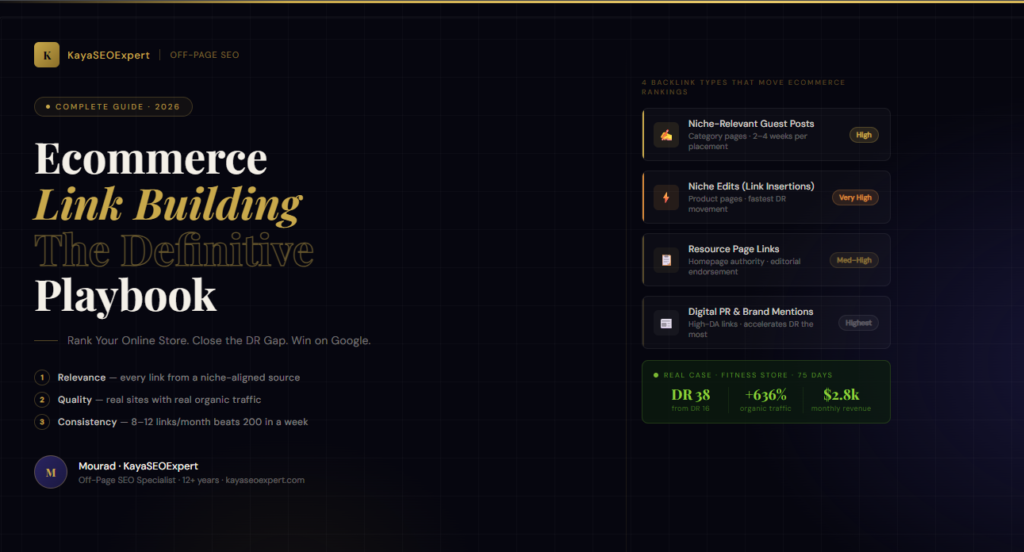
- DR: 16 → 38
- Organic traffic: 190 → 1,400+ visits/month
- Page 1 rankings: 2 → 19 keywords
- Organic revenue: $0 → approximately $2,800/month
No new products. No redesign. No paid ads. The content stayed exactly the same. The only variable was the backlink profile.
This is the compounding effect of ecommerce link building done correctly — and it explains why stores with weaker products consistently outrank stronger ones when their authority gap is large enough.
The Step-by-Step Ecommerce Link Building Plan
The plan below structures your ecommerce link building across three months — each with a clear focus, link velocity target, and measurable outcome.
Month 1 — Audit and Foundation
Week 1–2: Backlink Audit Before building anything, check what already exists. Use Ahrefs free backlink checker Semrush, or a free tool like Moz to review:
- Total referring domains
- Anchor text distribution
- Any toxic or spammy patterns that need disavowing
- Competitor backlink profiles — what sites link to them that don’t link to you
Week 3–4: Foundation Links Start with safe, diverse links that establish a natural profile:
- List your store in 5–10 niche-relevant directories with real traffic
- Set up and complete profiles on authoritative platforms (Google Business Profile, industry associations)
- Ensure your social profiles link back to your store
Link velocity in Month 1: 4–6 links per week maximum
Month 2 — Core Campaign
This is where the real authority building begins.
Niche edit outreach: Identify 20–30 articles on niche-relevant websites that mention products or topics related to your store but don’t link to you. Contact the site owners and offer a relevant addition.
Guest post campaign: Target 5–8 blogs in your niche with real traffic (check with Semrush or Ahrefs — any site with under 500 organic visits/month is not worth pursuing). Write genuinely useful articles. Include one natural link to a category page.
Anchor text discipline: For every 10 links you build, use roughly:
- 4 branded anchors (your store name or URL)
- 3 partial match anchors (related phrases containing your keyword)
- 2 generic anchors (“this resource,” “read more,” “click here”)
- 1 exact match (your target keyword exactly)
Link velocity in Month 2: 8–12 links per week
Month 3 — Scale and Measure
Review Search Console: By month 3, you should see DR movement of 5–15 points and position improvements on your target category pages. Use this data to identify which pages responded best and double down.
Scale what’s working: If guest posts on fitness blogs moved your fitness equipment category page, commission more of the same. If niche edits worked faster, prioritize them.
Start digital PR: If budget allows, begin one digital PR campaign — a survey, a data study, a useful calculator — that can earn high-DA coverage from industry publications.
Link velocity in Month 3: 10–15 links per week
| Month | Focus | Links/Week | Expected DR Movement |
|---|---|---|---|
| 1 | Audit + Foundation | 4–6 | 0–3 points |
| 2 | Guest Posts + Niche Edits | 8–12 | 5–10 points |
| 3 | Scale + Digital PR | 10–15 | 10–20 points |
If your store also serves customers in a specific city or region, local backlinks carry additional weight for location-based searches. The complete strategy for this is covered here: Effective Link Building for Local Business in 2026
The 5 Most Common Ecommerce Link Building Mistakes
Mistake 1: Building All Links to the Homepage
Google expects a natural distribution of links across your entire site. A store where 90% of backlinks point to the homepage looks manipulated — and your category and product pages get no direct authority benefit.
Mistake 2: Using the Same Anchor Text Repeatedly
If 30% of your backlinks use the exact same keyword phrase as anchor text, Google’s Penguin filter will suppress those rankings. Vary your anchors deliberately.
Mistake 3: Buying Bulk Link Packages
A 200-link package delivered in 72 hours is detectable as manipulation in seconds. The link velocity is wrong. The source diversity is wrong. The anchor distribution is wrong. Rankings typically drop within 2–3 weeks of these campaigns.
Mistake 4: Ignoring Competitor Backlink Gaps
Your competitors are already ranking. That means websites in your niche are already linking to similar stores. Those same websites are your best outreach targets — they’ve already demonstrated willingness to link to your type of content.
Export your top competitor’s backlink profile, filter for sites with real traffic, and work through that list systematically. This is the fastest way to close an authority gap.
Mistake 5: Stopping Too Early
The most common reason ecommerce link building “doesn’t work” is that the campaign was abandoned before results appeared. Link building has a compounding delay — the first 30 days typically show no movement at all. Results begin appearing in weeks 6–10. The stores that see the biggest gains are those that commit to consistent link building for 90+ days without stopping.
What to Look for in a Link Building Service
If you decide to work with an external link building specialist rather than doing outreach yourself, one question cuts through all the marketing noise:
“Can you show me the exact sites where my links will be placed, including their traffic data?”
A legitimate service answers this immediately and specifically. They name the sites. They show the traffic. They explain why each placement is relevant to your niche.
If the answer is vague — “we use high-DA sites,” “our network is exclusive,” “we can’t reveal our sources” — walk away. There is nothing to hide in legitimate link building.
Start With What You Can Measure
Ecommerce link building is not complicated, but it requires patience and consistency. The stores that win in Google search are not always the ones with the best products or the best website design. They’re the ones that built the most authority in their niche over time.
The three things that matter most:
- Relevance — every link should come from a site in or adjacent to your niche
- Quality — every linking site should have real organic traffic
- Consistency — 8–12 links per month for 90+ days beats 200 links in one week every time
If you want to know exactly where your store stands right now — your current DR, your competitor gap, and which pages need links most urgently — visit kayaseoexpert.com for a free backlink analysis.
I’ll review your store’s current profile and tell you honestly what’s working, what’s holding you back, and what to build next.
Written by Kaya SEO Expert — Off-Page SEO Specialist with 12+ years of experience helping ecommerce stores, businesses, and agencies build authority through strategic link building. Weekly SEO insights at kayaseoexpert.com