Here is a situation that plays out on thousands of websites every month.
A site owner reads that targeting multiple keywords increases traffic potential. They build a page targeting fifteen keyword variations — all related to their service, all with decent search volume, all included in the content. The page is published. Three months later, it ranks for none of them.
Meanwhile, a competitor page targeting one primary keyword and three carefully chosen secondary terms holds position four for the primary keyword, appears in featured snippets for two related queries, and gets cited in an AI Overview for a third. The competitor’s page generates twelve times the organic traffic.
The difference is not the number of keywords. It is the strategic relationship between the keywords on the page and how Google’s algorithm evaluates topical focus.
The question “how many SEO keywords per page” is actually the wrong question. The right question is: what is the keyword structure that allows a single page to rank for multiple related queries without diluting its relevance signal for any of them? That is what this guide answers — for the search environment that exists in 2026, not the one that existed three years ago.
Understanding how many seo keywords per page to target is the foundation of any effective content strategy.
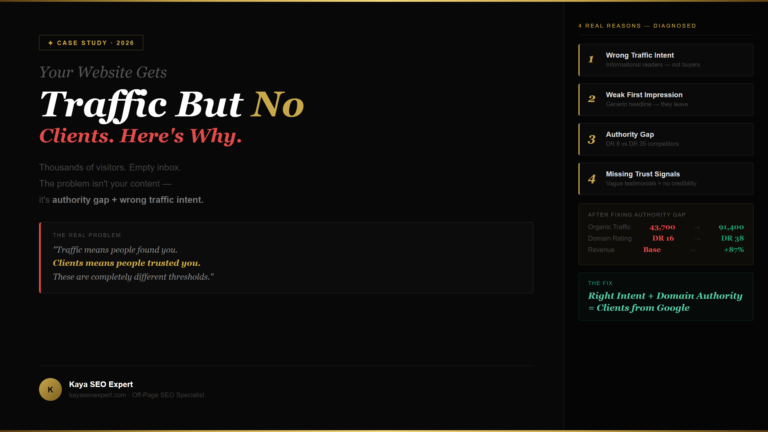
If your pages are already ranking but not producing clients or conversions, keyword targeting may not be the core issue. The analysis of traffic without conversions covers the distinction between a visibility problem and a conversion problem — worth understanding before rebuilding your keyword strategy.
The Short Answer — And Why It Changed in 2026
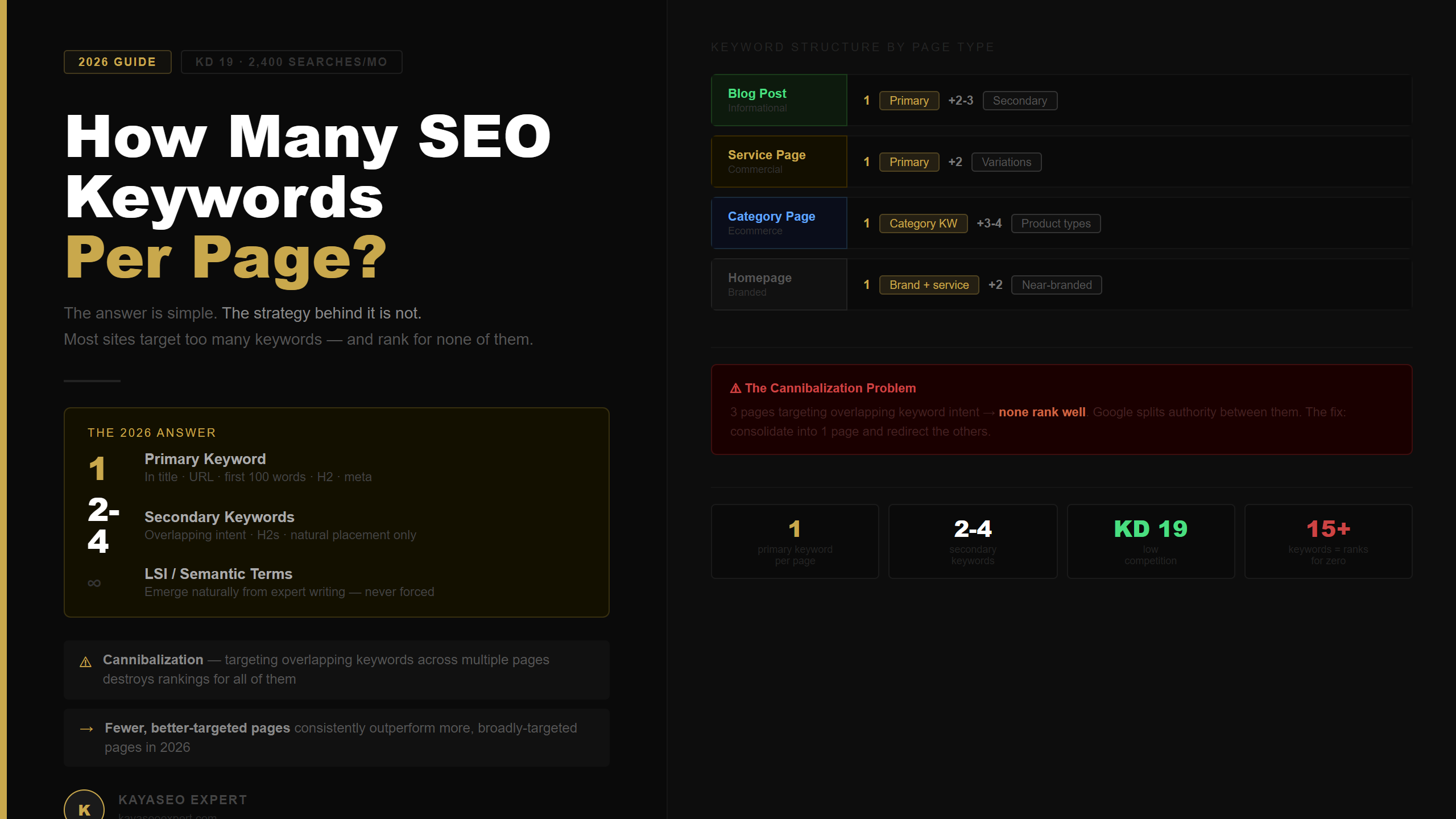
The technically accurate answer to how many SEO keywords per page: one primary keyword, two to four secondary keywords, and as many LSI (Latent Semantic Indexing) terms as occur naturally in well-written, comprehensive content.
But this answer requires significant qualification in 2026 because the way Google processes keyword signals has changed enough that applying older keyword targeting frameworks produces different results than they did two or three years ago.
What changed:
In earlier years, Google’s algorithm primarily matched pages to queries through keyword occurrence signals — how often a term appeared, where it appeared, and how it was formatted. More keyword occurrences in the right places correlated reliably with higher positions.
Google’s semantic search improvements, accelerated significantly between 2023 and 2026, shifted this toward intent and entity matching. The algorithm now evaluates whether your page addresses the underlying concept a searcher is exploring — not just whether it contains specific word sequences.
The practical consequence: a page that deeply covers a topic naturally contains the semantic signals for dozens of related queries without needing to explicitly target each one. A page stuffed with keyword variations but shallow on actual topical coverage will underperform a shorter, more specific page that genuinely answers the primary question.
The 2026 keyword structure that works:
When deciding how many seo keywords per page, start with the primary keyword first.
One primary keyword — the specific query your page is designed to rank for, appearing in title, URL, first paragraph, at least one H2, and naturally throughout the content.
Two to four secondary keywords — related queries with overlapping intent that a well-developed page on your topic would naturally address.
Semantic coverage — the related terms, concepts, and entities that competent writing on your topic naturally includes, without being forced or artificial.
This structure has not changed dramatically from what worked in 2022. What has changed is the relative weight of each component. Primary keyword signals matter somewhat less than they did. Semantic coverage and topical depth matter significantly more.
Primary vs Secondary vs LSI Keywords — The Real Difference
Most guides use these terms loosely. Understanding exactly what each category means — and how Google uses each — is essential for building a keyword structure that actually works.
Primary keyword:
The primary keyword is the specific search query your page is directly designed to rank for. It represents the exact question your page answers or the exact topic your page covers most comprehensively.
For a page about this topic, the primary keyword is “how many SEO keywords per page.” Every structural decision on the page — title tag, URL slug, first paragraph, primary H1 — is optimized to signal relevance for this specific query.
One page should have exactly one primary keyword. If you find yourself with two equally important target queries, you have two pages’ worth of content — not one page with two primaries.
Secondary keywords:
Secondary keywords are related queries with overlapping intent that your primary content naturally addresses as part of covering the topic thoroughly. A user who finds satisfying answers to their secondary query on your page has their intent met even though the page was not built specifically for them.
For this page, secondary keywords include: “keywords per page SEO,” “how many keywords should a page target,” and “keyword density per page.” A user searching any of these queries would find their question answered by a page built around the primary keyword — because the intent overlaps enough that one page serves all of them.
Secondary keywords should appear naturally in H2 subheadings, early paragraphs of relevant sections, and in the meta description where they fit without being forced. They should never appear because you inserted them artificially — only because they belong in the content you were going to write anyway.
LSI keywords:
LSI (Latent Semantic Indexing) keywords are the related terms, synonyms, and conceptually adjacent phrases that naturally occur in comprehensive writing on a topic. They are not keywords you target — they are signals you produce as a byproduct of writing well.
A page about keyword targeting will naturally contain terms like “search intent,” “keyword density,” “focus keyword,” “topical relevance,” “ranking signals,” and “content optimization” — not because you inserted them, but because you cannot write competently about the topic without using them.
Google uses these co-occurrence patterns to evaluate topical authority. A page about keyword targeting that contains no terminology from the broader SEO vocabulary signals shallow coverage. A page that naturally contains the vocabulary of the domain signals genuine expertise.
The actionable implication: do not try to identify and insert LSI keywords manually. Write comprehensive, expert-level content and the LSI signals will emerge naturally. If they do not, the content is too shallow — the solution is more depth, not more keyword insertion.
The relationship between keyword structure and overall SEO page content best practices is direct — keyword targeting is one component of a content quality framework, not a separate optimization exercise.
How Google Reads Keywords in 2026 — Semantic vs Exact Match
Understanding the shift from exact match to semantic matching is the key to understanding why keyword quantity rules changed.
The old model — exact match dominance:
Until approximately 2020-2021, Google’s ranking systems placed heavy weight on exact keyword matches. A page containing the exact phrase “how many SEO keywords per page” ranked better for that query than a page that covered the same topic without using that exact phrase.
This created the keyword optimization playbook most SEO guides still teach: identify the exact keyword phrase, include it in the title, URL, first paragraph, and multiple times throughout the content. Keyword density metrics were meaningful because they measured something the algorithm actually responded to.
The 2026 model — semantic and intent matching:
Google’s systems in 2026 evaluate meaning, not just word sequences. The algorithm asks: does this page provide a genuinely useful answer to what the searcher is trying to accomplish — regardless of whether it uses the exact words the searcher typed?
This is why a page titled “The Right Number of Target Keywords for Any Page” can rank for “how many SEO keywords per page” — the intent is identical even though the exact phrase does not appear in the title.
The practical implication for keyword targeting: exact match placement still matters for your primary keyword because it remains a relevance signal. But the obsessive repetition of exact phrases — the keyword density optimization that characterized earlier SEO — now produces diminishing returns beyond the initial placement signals.
What the algorithm evaluates instead:
Entity recognition — Google identifies the real-world entities your content discusses (people, places, concepts, organizations) and uses these to understand topical context.
Intent classification — the algorithm classifies queries into intent categories (informational, navigational, commercial, transactional) and evaluates whether your content’s format and depth match the dominant intent.
Semantic field coverage — the breadth and depth of related vocabulary in your content signals how comprehensively you have covered the topic.
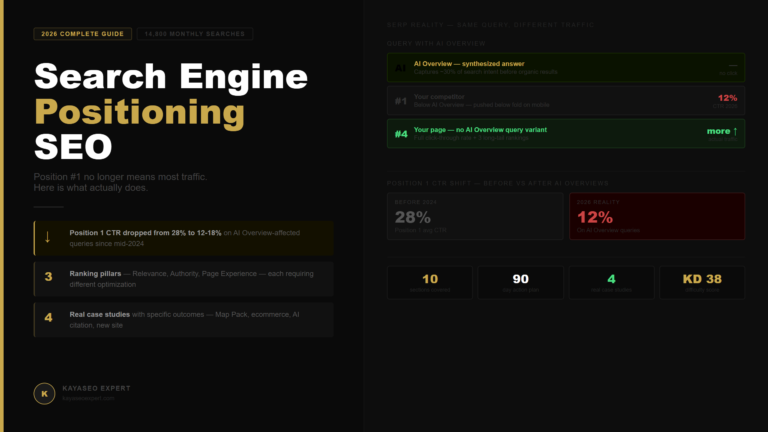
Understanding search engine positioning in this context is essential — the relationship between keyword signals and actual ranking positions runs through all three of these evaluation layers, not just keyword occurrence counts.
The Right Keyword Structure for Each Page Type
Different page types have different keyword targeting requirements. Applying the same keyword structure to every page type is one of the most common keyword targeting mistakes.
Blog posts and informational content:
Primary keyword: one specific informational query the post answers directly. Secondary keywords: two to three related questions the post naturally addresses while covering the primary topic. Structure: primary in title, URL, first 100 words, at least one H2. Secondaries in H2 subheadings where contextually appropriate.
The keyword count for blog posts depends primarily on length. A 1,500-word post typically supports one primary and two secondary keywords. A 3,000-word comprehensive guide can support one primary and four secondary keywords. Adding more secondary targets beyond what the content naturally addresses dilutes topical focus without expanding ranking potential.
Service pages:
Primary keyword: the specific service + location or qualifier that represents highest commercial value (e.g., “local SEO services Dallas” or “ecommerce link building specialist”). Secondary keywords: variations of the service name, related services mentioned on the page, and location variations if applicable. Structure: primary keyword in H1, in the first paragraph, in at least two H2s, and in the meta description. Secondaries in supporting sections.
Service pages have a narrower keyword structure than informational content because their intent is more specific. A service page targeting too many distinct service keywords signals to Google that it does not know what specific service it is about — which suppresses positions for all of them.
The local SEO audit framework applies this principle specifically to local service pages — where keyword targeting precision is especially important because local ranking signals are evaluated at the page level, not just the domain level.
Category pages for ecommerce:
Primary keyword: the product category name plus any relevant qualifier (e.g., “men’s running shoes,” “organic skincare products”). Secondary keywords: specific product types within the category, material or feature qualifiers searchers use. Structure: primary in H1 and page title, secondary keywords in category description text and product filter labels.
Ecommerce category pages require a different approach because their content is largely dynamic (product listings) rather than static editorial content. The static editorial content — the category description — carries the keyword signal burden for the entire page. This is why category descriptions of 200-300 words with careful keyword placement consistently outperform category pages with no editorial content, even when the product listings are identical.
The ecommerce link building framework covers how keyword targeting at the category page level interacts with the link building strategy for those pages specifically.
Homepage:
Primary keyword: your brand name plus core service descriptor (e.g., “KayaSEO Expert off-page SEO”). Secondary keywords: your primary service keywords, your geographic focus if applicable. Structure: primary in H1, secondary keywords in hero section subheadings and first body paragraph.
Homepages are the most misunderstood page type for keyword targeting. Many site owners try to rank their homepage for their most competitive industry keywords — resulting in a page that tries to be everything and ranks well for nothing. The homepage’s primary SEO function is to establish brand authority and distribute internal link equity to the pages that target specific keywords. It should target branded and near-branded terms, not competitive industry terms.
Keyword Cannibalization — How More Keywords Can Destroy Your Rankings
Keyword cannibalization is the condition where multiple pages on your site target the same or overlapping keyword intent, causing them to compete against each other rather than reinforce each other.
It is the most common consequence of aggressive keyword targeting across multiple pages — and one of the most damaging, because it suppresses rankings for all competing pages simultaneously.
How cannibalization happens:
A site creates a page targeting “local SEO guide.” Three months later, they create a page targeting “local SEO tips.” Six months after that, they create “local SEO checklist.” Each page seemed distinct when created. To Google, all three pages target the same searcher intent — someone looking for practical local SEO guidance.
Google is forced to choose between them for any local SEO query. Unable to determine which is the authoritative page on the topic, it ranks all three below where any single comprehensive page on local SEO would rank. The result: three pages that collectively generate less traffic than one consolidated page would.
How to identify cannibalization in your existing content:
Search for your target keyword in Google and note whether multiple pages from your site appear — even on different pages of results. If they do, you have cannibalization.
In Google Search Console, look at the queries report and identify queries where multiple pages from your site receive impressions. If the same query is driving impressions to two or more of your pages, those pages are competing.
A thorough content audit process identifies all cannibalization conflicts across your site systematically — producing a consolidation plan that resolves them in priority order.
How to fix cannibalization:
Identify the strongest of the competing pages — the one with the most backlinks, highest existing position, and most comprehensive content. Expand it to incorporate the best information from the competing pages. Redirect all weaker pages to the surviving page. Update internal links throughout your site to point directly to the surviving URL.
The result: one comprehensive page receiving the combined authority signals of all the pages that were previously competing. Ranking improvements following cannibalization resolution are typically faster and more significant than ranking improvements from new content or new links — because the underlying authority was already there, just being diluted.
How to Choose Secondary Keywords That Actually Expand Traffic
Secondary keyword selection is where most keyword targeting strategies either multiply their traffic potential or waste their effort on keywords that do not actually expand reach.
The intent overlap test:
A secondary keyword is valid for a given page if — and only if — a user searching for the secondary keyword would be satisfied by the page you built for the primary keyword. If satisfying the secondary keyword would require different content, a different format, or a different depth of coverage, it belongs on a different page.
“How many keywords per page” is a valid secondary keyword for a page targeting “how many SEO keywords per page” — the intent is identical, just phrased differently. “Keyword research tools” is not a valid secondary keyword for the same page — a user searching for tool recommendations needs different content than a user asking about keyword quantity.
The search volume reality check:
Secondary keywords with very low search volume (under 100 monthly searches) add minimal traffic even if you rank for them. The time spent specifically optimizing for them is rarely justified. Secondary keywords with volume over 500 represent meaningful additional traffic if you rank well for them — these are worth conscious placement.
The ranking position check:
Before adding a new secondary keyword to a page, check whether any existing page on your site already ranks for it — even at position 20-30. If it does, you risk creating cannibalization by adding that keyword to a second page. The better approach is to strengthen the existing ranking rather than compete against yourself.
Use Google Search Console‘s performance report to check existing rankings for your candidate secondary keywords before adding them to new content. This five-minute check prevents the months-long cannibalization problems that result from ignoring it.
The Practical Keyword Checklist Before You Publish
Before publishing any page, verify each of these:
This checklist applies regardless of how many seo keywords per page you have decided to target.
Primary keyword placement:
- ☐ Focus keyword appears in the page title (H1)
- ☐ Focus keyword appears in the URL slug
- ☐ Focus keyword appears in the first 100 words of body content
- ☐ Focus keyword appears in at least one H2 subheading
- ☐ Focus keyword appears in the meta description
- ☐ Focus keyword density is between 0.5% and 1.5% of total word count
Secondary keyword placement:
- ☐ Each secondary keyword appears in at least one H2 where contextually appropriate
- ☐ Secondary keywords appear naturally in the body content — not forced
- ☐ Secondary keyword density is lower than primary keyword density for each term
Cannibalization check:
- ☐ No existing page on your site already targets the same primary keyword intent
- ☐ No existing page already targets any of your secondary keyword intents
- ☐ The page you are about to publish will not split traffic with an existing page
Semantic coverage check:
- ☐ The content naturally contains vocabulary from the broader topic area
- ☐ You have not artificially inserted keyword phrases that do not read naturally
- ☐ The content answers follow-up questions a searcher would logically have after the primary question
If any of these boxes is unchecked, the issue it identifies is worth resolving before publishing. A page published with structural keyword problems will typically rank below its potential regardless of its content quality or the links built to it.
The Number Nobody Talks About
The question of how many seo keywords per page has a specific answer
— one primary, two to four secondary, unlimited natural semantic terms — but the more useful question is different.
How few keywords can a page target while still capturing all the relevant traffic in its topic area?
The discipline of reducing keyword targets to the minimum required for comprehensive coverage consistently produces better results than adding targets to maximize theoretical reach. Each additional keyword target adds complexity without proportionally adding traffic potential. Each reduction in keyword targets adds topical focus that benefits the remaining targets.
The sites that rank most consistently across competitive keyword clusters are typically those with the fewest pages per topic, each built around the clearest and most specific primary target. Not the sites with the most pages, or the most keywords per page, or the most comprehensive keyword coverage maps.
Fewer, better-targeted pages consistently outperform more, broadly-targeted pages — in 2026 more than at any previous point in Google’s history, because the algorithm’s ability to evaluate topical precision has never been more sophisticated.
If you want a keyword targeting review of your existing pages — identifying which primary targets are misaligned, which secondary targets are creating cannibalization, and which pages have the highest improvement potential — that analysis is available at kayaseoexpert.com.