If you want to rank on Google Maps local business
style — dominating the top 3 — you’ve probably done
everything the guides tell you to do.
Your Google Business Profile is complete. You have photos, hours, services, and a description packed with keywords. You’ve collected dozens of reviews. Your NAP — name, address, phone number — is consistent everywhere.
And still, when someone searches for your business category in your city, your competitors show up. You don’t.
Here’s what most local SEO guides miss: Google Maps rankings aren’t decided by your Business Profile alone. They’re decided by how much Google trusts your entire online presence — and that trust is built through your website, not your profile.
This guide covers exactly how Google Maps rankings work in 2026, what the top-ranking businesses have that you don’t, and the step-by-step process to close that gap.
How Google Maps Rankings Actually Work
Google Maps uses three core factors to decide which businesses appear in the local pack — the top 3 results that show up with a map when someone searches for a local business.
Relevance — Does your business match what the person searched for? This is controlled by your business categories, your profile description, and the keywords in your reviews and posts.
Distance — How close is your business to the searcher? This is the one factor you can’t change — it’s based on your physical location.
Prominence — How well-known and trusted is your business online? This is where most local businesses lose — and it’s where the real work happens.
Prominence is the factor that separates the businesses ranking in the top 3 from the businesses stuck on page 2. It’s determined by:
- Your website’s Domain Rating (DR) — how authoritative Google considers your site
- The number and quality of local citations across the web
- Backlinks pointing to your website from other trusted sites
- Review quantity and recency on your Google Business Profile
Most businesses focus entirely on reviews and ignore the other three. That’s why they stay stuck.
The Hidden Factor: Website Authority
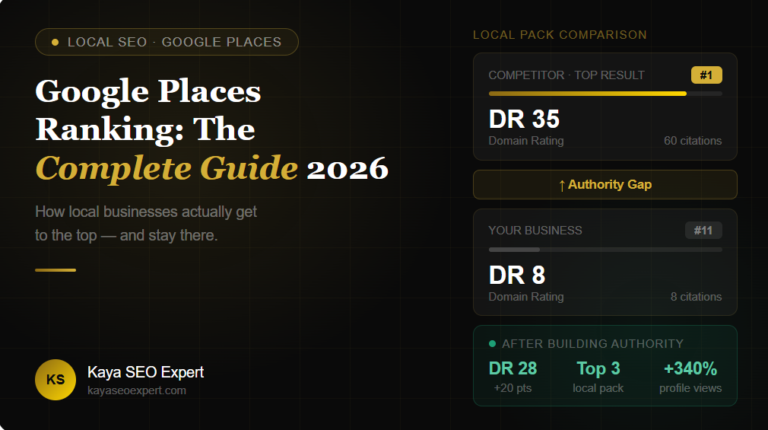
If two businesses are equally relevant and equally close to the searcher, Google uses website authority as the tiebreaker. And in competitive local markets, it’s not even close — the businesses ranking at the top have significantly higher Domain Ratings than the businesses ranking below them.
Domain Rating (DR) is a metric from Ahrefs that measures the strength of a website’s backlink profile on a scale of 0 to 100. A business with DR 30 has a fundamentally stronger online presence than a business with DR 8 — and Google’s algorithm reflects this directly in Maps rankings.
Here’s what this looks like in practice:
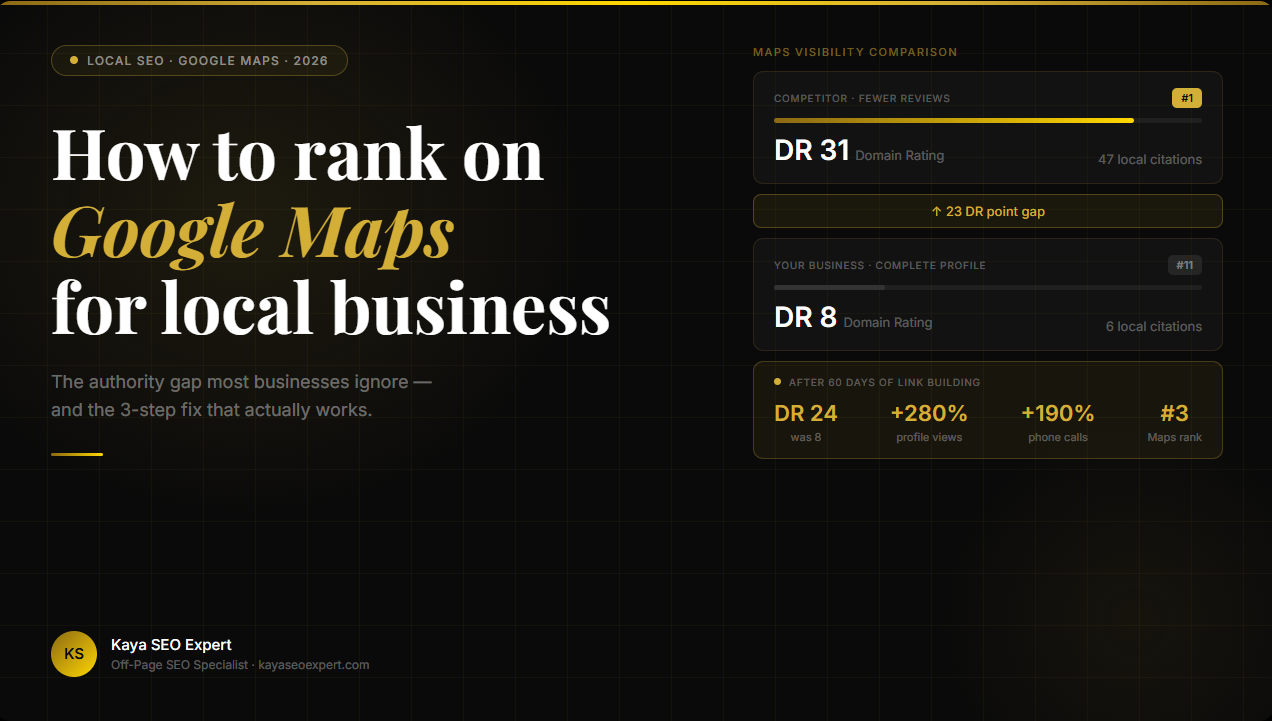
A dental clinic with 47 reviews and a DR of 8 ranked #11 on Google Maps in its city. The clinic ranking #1 had only 23 reviews — but a DR of 31 and 47 local citations.
The profile with fewer reviews was outranking the profile with more reviews because its website was significantly more authoritative.
This is the pattern across almost every local market: the businesses ranking at the top have higher DR scores and more citations than the businesses below them — regardless of profile completeness or review count.
For a full breakdown of how to build the backlink foundation your local business needs, this guide covers the complete strategy: Effective Link Building for Local Business in 2026
The 3-Step Process to Rank on Google Maps Local Business Rankings
Step 1 — Audit the Gap Before You Build Anything
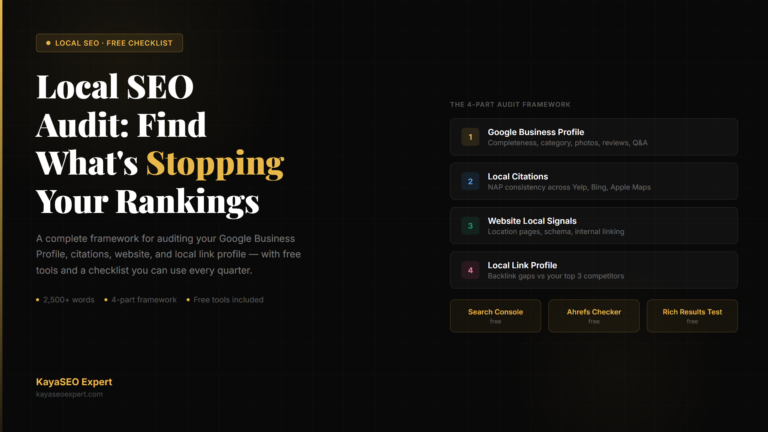
Before doing any work, find out exactly where you stand relative to the businesses ranking above you.
Check your Domain Rating: Go to Ahrefs Webmaster Tools (free) or Ubersuggest and enter your website URL. Note your current DR score.
Check your competitors’ DR: Enter the websites of the 3 businesses ranking in the top spots for your main keyword on Google Maps. Note their DR scores.
Check your citation count: Search for your business name on Google and count how many directories and sites list your business with consistent NAP information.
Check your competitors’ citations: Do the same for the top-ranking businesses. Tools like BrightLocal or Whitespark can automate this.
The difference between your numbers and your competitors’ numbers is your gap. Now you have a specific target instead of a vague goal.
Step 2 — Build Local Citations Systematically
A local citation is any mention of your business name, address, and phone number on the web — with or without a link. Citations tell Google that your business is real, established, and present in your community.
Start with the major platforms that every local business needs:
- Google Business Profile (if not already done)
- Bing Places for Business
- Apple Maps
- Facebook Business Page
- Yelp
- Foursquare
- TripAdvisor (if relevant to your industry)
- Better Business Bureau
After the major platforms, move to industry-specific directories. A restaurant should be on Zomato, OpenTable, and local food blogs. A law firm should be on Avvo, FindLaw, and Justia. A dental clinic should be on Healthgrades and Zocdoc.
Finally, add local directories specific to your city or region — local chamber of commerce listings, city business directories, and regional news site business listings.
The rule for citations: NAP must be identical everywhere. Even small variations — “St.” vs “Street,” different phone number formats — can dilute the signal. Pick one format and use it consistently across every platform.
Target 40–60 citations before moving to backlink building. This foundation alone can move a business from position 15 to position 8 in some markets.
Step 3 — Build Backlinks to Your Website
Citations establish that your business exists. Backlinks establish that your business is trusted by other credible sources — and this is what pushes you into the top 3.
For local businesses, the most effective backlinks come from:
Local news and media sites Get featured in a local news article, a community blog post, or a regional magazine. These links carry significant weight because local news sites have high authority and clear geographic relevance.
Local event sponsorships Sponsor a local event, charity, school program, or community organization. Most will include a link to your website from their sponsors page. These are easy to acquire and highly relevant.
Partner business mentions If you work with complementary local businesses — a photographer partnering with a wedding venue, a plumber partnering with a general contractor — arrange mutual mentions with links on each other’s websites.
Local business associations Join your local chamber of commerce, business improvement district, or trade association. Most include a member directory with a link to your website.
Guest content on local platforms Write a guest article or expert column for a local blog, news site, or industry publication. You provide value to their audience; they provide a link back to your site.
For local businesses that also serve an online market or want to scale their link building beyond local sources, the complete approach is covered here: Ecommerce Link Building: Complete Guide 2026
Case Study: From #11 to #3 in 60 Days
A dental clinic came to me ranking #11 on Google Maps in a mid-sized city. The profile was complete — 47 reviews, professional photos, every field filled in. But the website had a DR of 8 and only 6 local citations.
The top-ranking competitor had 23 reviews but a DR of 31 and 47 local citations.
The work over 60 days:
- Built citations on 40 additional local and industry-specific directories
- Secured a link from a regional health and wellness blog (guest post)
- Got featured in a local online newspaper article about dental care
- Joined the local chamber of commerce (directory link)
- Arranged a partnership mention with a nearby orthodontist practice
Results after 60 days:
| Metric | Before | After |
|---|---|---|
| Domain Rating | 8 | 24 |
| Local citations | 6 | 46 |
| Google Maps position | #11 | #3 |
| Profile views/month | 340 | 1,295 |
| Phone calls from Maps | 18/month | 52/month |
The profile didn’t change. The website authority did.
Businesses that want to rank on Google Maps local business
searches need to focus on website authority first.
Common Mistakes That Keep Local Businesses Stuck
Most businesses trying to rank on Google Maps local business results make the same critical mistake — they focus on the wrong things.
Mistake 1: Only Optimizing the Google Business Profile
Profile optimization gets you to a baseline. It doesn’t get
you to the top 3. The businesses stuck at position 8–15 almost always have well-optimized profiles — and weak websites.
Mistake 2: Ignoring Citations Entirely
Skipping the citation foundation and going straight to backlinks is like building a second floor without a first. Citations are the baseline that makes backlinks effective.
Mistake 3: Building Low-Quality Backlinks
Cheap backlink packages from directories with no traffic or
relevance don’t move Maps rankings. Worse, they can create a negative signal. Every backlink needs to come from a site that is genuinely relevant to your location, industry, or audience.
Mistake 4: Expecting Results in Two Weeks
Google Maps rankings respond to authority signals over time.
The citation work starts showing results in 4–8 weeks. The backlink work starts showing results in 6–12 weeks. Businesses that stop after 30 days are stopping right before the results arrive.
Mistake 5: Focusing Only on Reviews After the Foundation is Built
Once your citations and DR are competitive with the top-ranking businesses, reviews become the tiebreaker. At that point, asking satisfied customers for reviews immediately after a positive experience becomes highly effective.
What to Do Right Now
If your business isn’t showing up on Google Maps the way it should, the first step is the audit in Step 1 of this guide. Find out the exact DR gap between you and the businesses ranking above you.
That number tells you how much work is ahead — and gives you a realistic timeline for results.
Visit kayaseoexpert.com for a free backlink analysis. I’ll review your website’s current authority, check what the top-ranking local competitors have that you don’t, and tell you exactly what needs to be built to close the gap.
No package pitch. No upsell. A straight answer about where you stand and what to do next.
The businesses that rank on Google Maps local business searches consistently are the ones that invest in website authority — not just profile optimization.
Written by Kaya SEO Expert — Off-Page SEO Specialist helping local businesses build the authority needed to rank on Google Maps and Google Search. Weekly insights at kayaseoexpert.com