A site with 200 published articles was losing organic traffic every month.
Not because the new content was bad. Not because competitors were outranking individual pages. The traffic was declining because Google’s Helpful Content system had evaluated the site’s overall content quality and assigned it a suppressed quality signal — meaning even the good pages were ranking below their potential because they shared a domain with dozens of thin, outdated, and irrelevant pages.
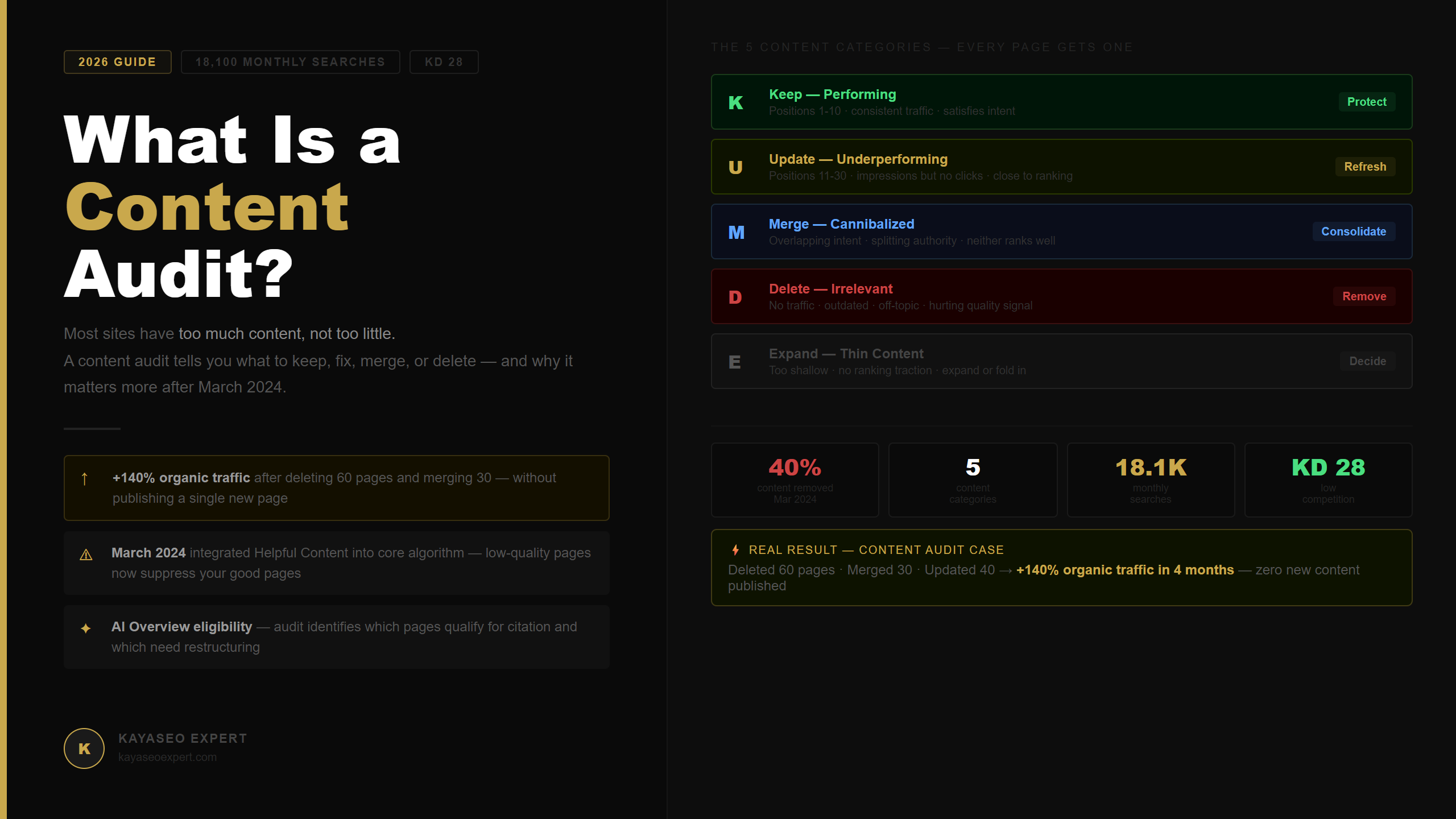
The site owner’s instinct was to publish more content. The actual solution was to audit what already existed, delete 60 pages, merge 30 others, and update 40 more. Within four months of completing the audit, organic traffic increased 140% — without publishing a single new page.
This is what a content audit actually does in 2026. Not a spreadsheet exercise. Not a vanity metric review. A strategic decision process that determines which content on your site is helping your rankings, which is neutral, and which is actively hurting your ability to compete.
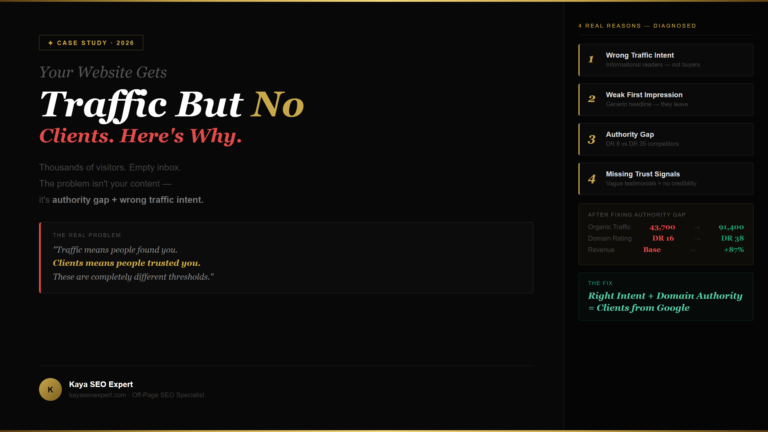
If your site is publishing consistently but traffic is stagnant or declining, the problem is almost certainly not that you need more content. The problem is that you need a clearer picture of what your existing content is doing — covered in the broader framework of why websites get traffic but produce no results.
What Is a Content Audit — The Real Definition in 2026
What is a content audit in practical terms? A content audit is a systematic evaluation of every piece of content on your website to determine its current performance, its quality relative to Google’s 2026 standards, and the specific action it requires — whether that is keeping it as-is, updating it, merging it with other content, redirecting it, or deleting it entirely.
What is a content audit if not a strategic reset for your entire content library? The definition sounds straightforward. The execution is not — because what constitutes “quality” in 2026 is meaningfully different from what it meant in 2022 or even 2023.
A content audit in 2022 primarily asked: is this page optimized? Does it have the right keywords, the right structure, the right meta description?
A content audit in 2026 asks something more fundamental: does this page demonstrate first-hand experience, satisfy a specific search intent with precision, and contribute positively to the overall quality signal of the domain it lives on?
These are different questions. They produce different diagnoses. And they require different remediation strategies.
What a content audit is not:
What is a content audit compared to regular SEO optimization? A content audit is not an SEO checklist applied to individual pages. Checking whether each page has a focus keyword, a meta description, and proper heading structure is on-page optimization — a different activity with a different purpose.
A content audit is not a traffic report. Knowing which pages receive the most traffic tells you which pages are currently performing, not which pages should be kept, updated, or removed.
A content audit is not a one-time project. Sites that run a content audit once and never revisit it accumulate the same quality problems within twelve to eighteen months. A content audit is a recurring process.
Why Content Audits Matter More After March 2024
The March 2024 core update was the most significant content quality intervention Google has made in years. Understanding what it changed is essential for understanding why content audits became a higher priority after it.
The Helpful Content system integration.
Before March 2024, Google’s Helpful Content system operated as a separate classifier that ran alongside the core algorithm. After the March 2024 update, it was integrated into the core ranking system — meaning its signals now influence every ranking decision rather than operating as a parallel filter.
The practical consequence: the overall content quality of your domain now affects the ranking potential of every individual page on that domain. A site with 20 excellent pages and 80 thin or unhelpful pages will see its 20 excellent pages ranked below their potential — because the site-level quality signal is suppressed by the 80 underperforming pages.
This is the mechanism behind many of the traffic declines that began in March 2024 and continued through subsequent updates. Sites that lost traffic did not necessarily have bad content. They had good content sitting on domains with too much mediocre content.
The AI Overviews eligibility factor.
Google’s AI Overviews draw from pages it considers authoritative, current, and specifically relevant to the query components they address. Pages with outdated statistics, thin explanations, or generic coverage that lacks specific detail are less likely to be cited in AI Overviews — even if they rank organically.
A content audit identifies which pages have the characteristics that make them AI Overview candidates and which need updating to become eligible. The SEO page content best practices framework defines those characteristics in detail — a content audit is the diagnostic tool that tells you which pages meet that standard and which do not.
The cannibalization problem at scale.
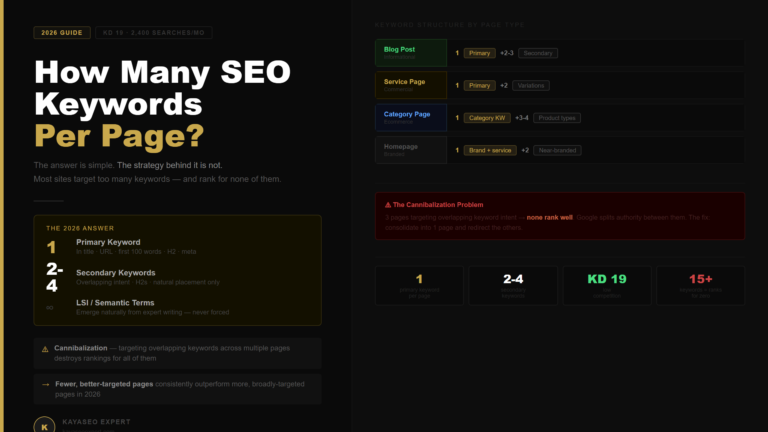
Sites that publish regularly without auditing accumulate keyword cannibalization systematically. Topics that were distinct when first written gradually overlap as the content library grows. Google is forced to choose between competing pages for the same query — and often ranks none of them well.
A content audit surfaces these cannibalization conflicts and identifies the consolidation opportunities that resolve them. The result is typically a meaningful ranking improvement for the surviving consolidated page — it now receives the combined authority signals of the pages that were previously splitting them.
The search engine positioning implications.
Sites that have completed content audits consistently report improved search engine positioning for their target keywords — not because they built new links or published new content, but because removing low-quality content lifted their site-level quality signal and allowed their good pages to rank at their actual potential.
The 5 Types of Content a Content Audit Finds
A well-executed content audit categorizes every page on your site into one of five categories. Understanding these categories before you start the audit helps you make decisions faster and more consistently as you work through your content inventory.
Category 1: Performing Content — Keep and Protect
These are pages currently ranking in positions 1-10 for meaningful keywords, generating consistent organic traffic, and receiving engagement signals (time on page, low bounce rate, conversions) that confirm they are satisfying search intent.
The action for this category is protection, not optimization. These pages should be monitored for ranking stability, updated when their topic evolves, and used as sources of internal links to underperforming pages. The primary risk for performing content is neglect — competitors will eventually publish more current, more comprehensive content, and rankings will decline if you do not maintain these pages.
Category 2: Underperforming Content — Update and Strengthen
These are pages ranking between positions 11-30 for their target keywords, receiving impressions but minimal clicks, or generating traffic without conversions. They have established some relevance signal — Google has indexed them and assigned them some ranking authority — but they have not reached their competitive potential.
This is the highest-ROI category for most sites. These pages are close to performing. The gap between their current position and a top-ten position is usually a content quality gap, not an authority gap — meaning updates can close it without requiring additional link building.
The update agenda for these pages is determined by comparing them to what currently ranks in positions 1-5 for their target query: what do the ranking pages have that yours does not? More specific information? More current data? Better structural organization? A more direct answer to the primary question?
Category 3: Cannibalized Content — Merge
These are pages targeting the same or overlapping search intent as another page on your site. Neither page ranks as well as a single consolidated page would, because they are splitting authority signals and confusing Google’s intent matching.
Cannibalization is identified by checking which of your pages appear in the same search results for the same queries. If two or more of your pages appear together — even on different result pages — for the same keyword cluster, they are cannibalized.
The merge process: identify the stronger of the competing pages (typically the one with more backlinks, higher existing position, and more comprehensive content), migrate the unique content from the weaker pages into it, and redirect the weaker URLs to the surviving page. The surviving page inherits the combined authority of all merged pages.
Category 4: Irrelevant or Outdated Content — Delete or Redirect
These are pages that no longer serve your current audience, cover topics entirely unrelated to your site’s focus, contain information that is factually outdated without being updated, or were published for reasons that no longer apply (old promotions, discontinued products, obsolete topics).
This is the category most site owners resist because deleting content feels like losing something. The reality is that these pages are actively harming your site-level quality signal. A domain with 150 pages where 40 are irrelevant or outdated has a lower quality signal than the same domain with 110 pages where all are relevant and current.
For pages with zero organic traffic and no backlinks: delete and set to 404, or redirect to the most topically related surviving page.
For pages with backlinks but low traffic and declining relevance: redirect to the most relevant surviving page to preserve the link equity before removing the content.
Category 5: Thin Content — Expand or Consolidate
These are pages that cover a topic too superficially to compete for meaningful search positions. They may be indexed and receive occasional impressions, but they never accumulate ranking traction because their content does not satisfy the depth requirement for their target queries.
Thin content has two remediation paths: expand it into a substantive piece that can compete for its target keyword, or consolidate it with a related piece that covers the topic more comprehensively. The choice depends on whether the topic warrants a dedicated page at the depth required to rank, or whether it is better treated as a section within a larger page.
The Step-by-Step Content Audit Process for 2026
A content audit has four phases: inventory, assessment, categorization, and action. Each phase builds on the previous one.
Phase 1: Build Your Content Inventory
Before starting Phase 1, understanding what is a content audit helps you set realistic expectations for the process.
Before you can assess your content, you need a complete list of every page on your site. The fastest method:
Export from Google Search Console: Go to Performance → Pages. Set the date range to the last 12 months. Export all pages. This gives you every page that has received at least one impression in the last year.
Supplement with a site crawl: Use Screaming Frog’s free version (up to 500 URLs) or Google Search Console’s URL Inspection tool to identify pages that may not have received impressions — unpublished drafts that were accidentally indexed, old pages outside your current site architecture, or orphaned pages with no internal links.
Combine both lists into a spreadsheet with these columns: URL, Page Title, Word Count, Last Updated Date, Impressions (12 months), Clicks (12 months), Average Position, Referring Domains.
The last two columns — Average Position and Referring Domains — come from Google Search Console and Ahrefs’ free backlink checker respectively. They are essential for the categorization phase.
Phase 2: Assess Each Page Against 2026 Quality Standards
For each page in your inventory, evaluate four dimensions:
Relevance: Does this page address a topic your target audience actively searches for? Is the search intent accurately matched by the content format and depth?
Currency: Is the information current? Does it reflect 2025-2026 reality, or is it based on conditions that no longer apply? Specifically for SEO content: does it account for AI Overviews, the March 2024 core update, and E-E-A-T signals?
Depth: Is the content comprehensive enough to compete for its target position? Compare the page’s word count and information density to what currently ranks in the top three for its primary query.
Experience signals: Does the page demonstrate first-hand knowledge through specific numbers, real outcomes, documented processes, or observations that generic content cannot replicate?
Pages that fail multiple dimensions are candidates for significant update or removal. Pages that fail one dimension have a targeted improvement agenda.
Phase 3: Categorize Every Page
Using the five categories defined above, assign each page a category and a priority level:
Priority 1 — Immediate action: pages in the Cannibalized or Irrelevant categories. These are actively harming your site-level quality signal and should be addressed before anything else.
Priority 2 — High ROI: pages in the Underperforming category ranking between positions 11-20. These are closest to performing and require the least investment to move.
Priority 3 — Maintenance: pages in the Performing category. These need monitoring and periodic refresh but no immediate intervention.
Priority 4 — Strategic decision: pages in the Thin category. These require a decision about whether the topic warrants investment or whether the page should be folded into existing content.
Phase 4: Execute Actions in Priority Order
The execution sequence matters. Fixing cannibalization before updating underperforming content allows the updated content to benefit from consolidated authority signals. Removing irrelevant content before assessing performing content gives you a cleaner baseline for quality assessment.
A full local SEO audit applies this same prioritization framework to local SEO signals specifically — the diagnostic approach is identical, the signals being evaluated differ.
Tools You Need to Run a Content Audit
A thorough content audit requires data from several sources. Here are the essential tools, organized by cost.
Free tools that cover the essentials:
Google Search Console — search.google.com/search-console — Provides impressions, clicks, average position, and CTR for every page. The primary data source for understanding which pages are visible in search and where they rank. Essential and irreplaceable.
Google Analytics — Provides engagement data: time on page, bounce rate, pages per session, and conversion data. Tells you whether traffic that arrives is actually engaging with your content or immediately leaving.
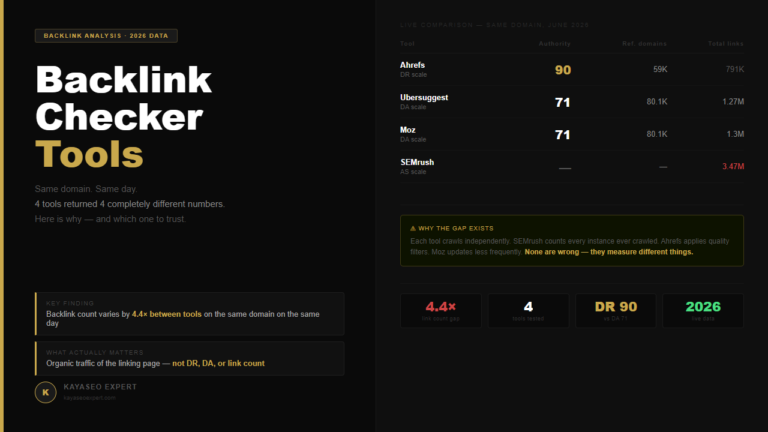
Ahrefs Free Backlink Checker — Shows referring domains for any URL. Essential for the categorization phase — you need to know which pages have backlinks before deciding whether to delete them.
Screaming Frog SEO Spider (free up to 500 URLs) — Crawls your site and exports a complete page inventory with meta data, word counts, and technical signals. The fastest way to build your initial content inventory.
Paid tools that accelerate the process:
Ahrefs Site Audit — Identifies thin content, duplicate content, and broken internal links automatically. Significantly reduces the manual assessment time for large sites.
SEMrush Content Audit tool — Integrates with Google Analytics and Search Console to score content quality automatically. Useful for sites with hundreds of pages where manual assessment is impractical.
For most sites under 200 pages, the free tools are sufficient to run a complete and effective content audit.
What to Do With Each Content Category
The categorization phase tells you what each page needs. The action phase determines how to execute efficiently.
Performing content — maintenance protocol:
Set a review calendar for every performing page: quarterly review for pages in positions 1-3, biannual review for pages in positions 4-10. At each review: update statistics and data to current figures, add new sections addressing developments since the original publish date, and check that internal links reflect your current content architecture.
Underperforming content — update protocol:
For each underperforming page: identify the primary keyword and search the current results. Read the top three ranking pages. Build a specific list of what they contain that your page does not. Update your page to include the missing information, improve the structural organization, and add experience signals where they are absent. Update the publish date after significant changes.
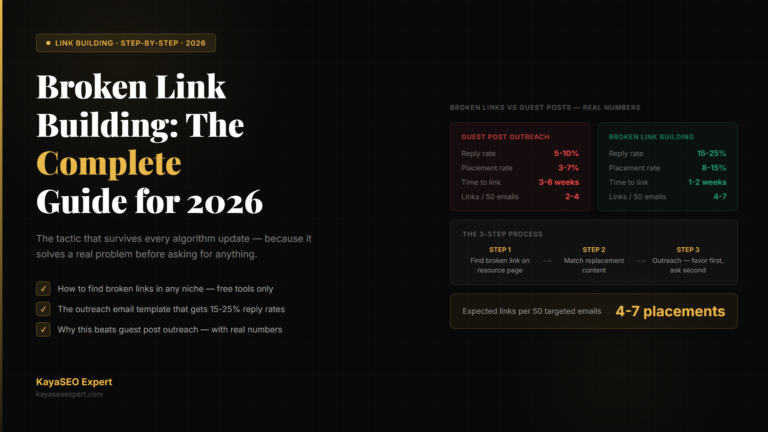
After updating, request re-indexing in Google Search Console and add internal links to the updated page from your two or three highest-authority pages. The broken link building process applies a similar principle at the external link level — identifying pages that should be linking to your updated content and outreaching for placements.
Cannibalized content — merge protocol:
Identify the surviving page (the one to keep). Copy any unique content from the pages being merged into the surviving page. Expand the surviving page to incorporate the best information from all merged pages. Set up 301 redirects from all merged URLs to the surviving URL. Update internal links throughout your site to point directly to the surviving URL rather than through redirects. Request re-indexing of the surviving page.
Irrelevant or outdated content — removal protocol:
Before removing any page, check its backlink profile. If the page has referring domains, identify the most topically relevant page on your site and set up a 301 redirect before removing the content. If the page has no referring domains and no organic traffic, a 404 is acceptable — but a redirect to a related page is always preferable to preserve any residual equity.
Thin content — expansion or consolidation decision:
The decision criterion: if the topic can support 1,500+ words of genuinely useful, specific content, expand it. If it cannot — if it is a narrow subtopic that is better treated as a section within a larger page — consolidate it into the most relevant existing page and redirect the thin page’s URL to the expanded page.
The ecommerce link building guide illustrates this at the link-building level: individual thin tactics covered in isolation are less effective than a comprehensive strategy page that covers the full approach — the same principle applies to content consolidation.
Content Audit for AI Overview Eligibility
This is the dimension of content audits that most guides published before 2025 do not address — and it is increasingly important as AI Overviews capture a growing share of search results page real estate.
AI Overviews draw from pages that meet a specific set of characteristics. A content audit that evaluates these characteristics tells you which pages are currently eligible for Overview citation and which need modification to become eligible.
The characteristics AI Overviews favor:
Direct-answer density: Pages that provide concise, specific answers to discrete sub-questions within the broader topic. Each H2 that frames a question and immediately answers it in the first paragraph is a potential Overview citation candidate.
Factual specificity: Specific statistics, specific dates, specific outcomes. “Rankings improved significantly” is not citable. “Rankings improved from position 22 to position 6 over eleven weeks” is citable.
Source credibility signals: Author bylines, publication dates, citations to primary sources, and organizational information that Google’s systems can use to evaluate trustworthiness.
Content currency: Pages last updated more than twelve months ago on fast-moving topics (AI, SEO, algorithm changes) are less likely to be cited because their information may be outdated.
The AI Overview content audit checklist:
For each page you want to optimize for AI Overview citation:
Does each H2 framing a question immediately answer that question in the first 1-2 sentences of the section? If not, restructure the opening of each section to lead with the direct answer.
Does the page include at least three specific statistics or data points that could be extracted as standalone factual claims? If not, add specific numbers from your own experience or from primary sources.
Is the page’s last updated date within the last six months for a fast-moving topic? If not, update the page and its statistics before expecting Overview consideration.
Does the page have FAQ schema markup? If not, add it to the sections that directly answer specific questions.
The Content Audit Template — Ready to Use
Copy this structure into a spreadsheet for your audit:
Column headers:
URL | Page Title | Word Count | Last Updated | Impressions (12mo) | Clicks (12mo) | Avg Position | Referring Domains | Category | Priority | Action | Status
Category codes:
- K — Keep (Performing)
- U — Update (Underperforming)
- M — Merge (Cannibalized)
- D — Delete/Redirect (Irrelevant)
- E — Expand or Consolidate (Thin)
Priority codes:
- P1 — Immediate (Cannibalized/Irrelevant)
- P2 — High ROI (Underperforming, positions 11-20)
- P3 — Maintenance (Performing)
- P4 — Strategic Decision (Thin)
Action column values: Refresh statistics | Add experience signals | Restructure headings | Merge with [URL] | Redirect to [URL] | Delete | Expand to [target word count] | No action needed
Work through your content inventory systematically, assigning a category and action to each page before moving to execution. Attempting to execute and categorize simultaneously slows the process and reduces consistency.
How Often to Run a Content Audit
Content audit frequency depends on your publication rate and your site’s age.
Knowing what is a content audit and when to run it separates proactive SEO from reactive SEO.
For sites publishing 2+ pieces per month: quarterly audit of new content, annual comprehensive audit of the full site.
For sites publishing 1 piece per month or less: biannual comprehensive audit.
Trigger-based audits: run a targeted audit immediately after any major Google algorithm update. The March 2024 core update, for example, was a clear trigger for a full audit — sites that ran audits in April and May 2024 and addressed quality issues were better positioned for subsequent updates than those that waited.
The audit cadence should be built into your content calendar as a scheduled recurring activity, not treated as a crisis response to traffic declines. By the time declining traffic makes an audit feel urgent, the quality problems causing the decline have usually been accumulating for six to twelve months.
The Most Important Thing a Content Audit Tells You
What is a content audit telling you at this point? After running dozens of content audits, the most consistent finding is this: most sites have too much content, not too little.
The instinct to publish more — to fill gaps, to target new keywords, to maintain consistency — creates sites where the volume of mediocre content suppresses the performance of excellent content. The Helpful Content system, integrated into Google’s core algorithm since March 2024, made this dynamic explicit and measurable for the first time.
A content audit tells you the ratio of content that is helping your site to content that is neutral or harmful. For most sites that have been publishing for more than two years, this ratio is worse than the site owner expects.
The prescription is almost always the same: do less, but better. Fewer pages, each of which demonstrates genuine expertise through specific experience, satisfies a specific search intent with precision, and contributes positively to the domain’s overall quality signal.
That is what Google’s algorithm is trying to identify and rank. A content audit is the tool that shows you clearly where your current content stands relative to that standard — and what specifically needs to change.
If you want a content audit conducted on your site with specific recommendations for each page and a prioritized action plan, that work is available at kayaseoexpert.com.