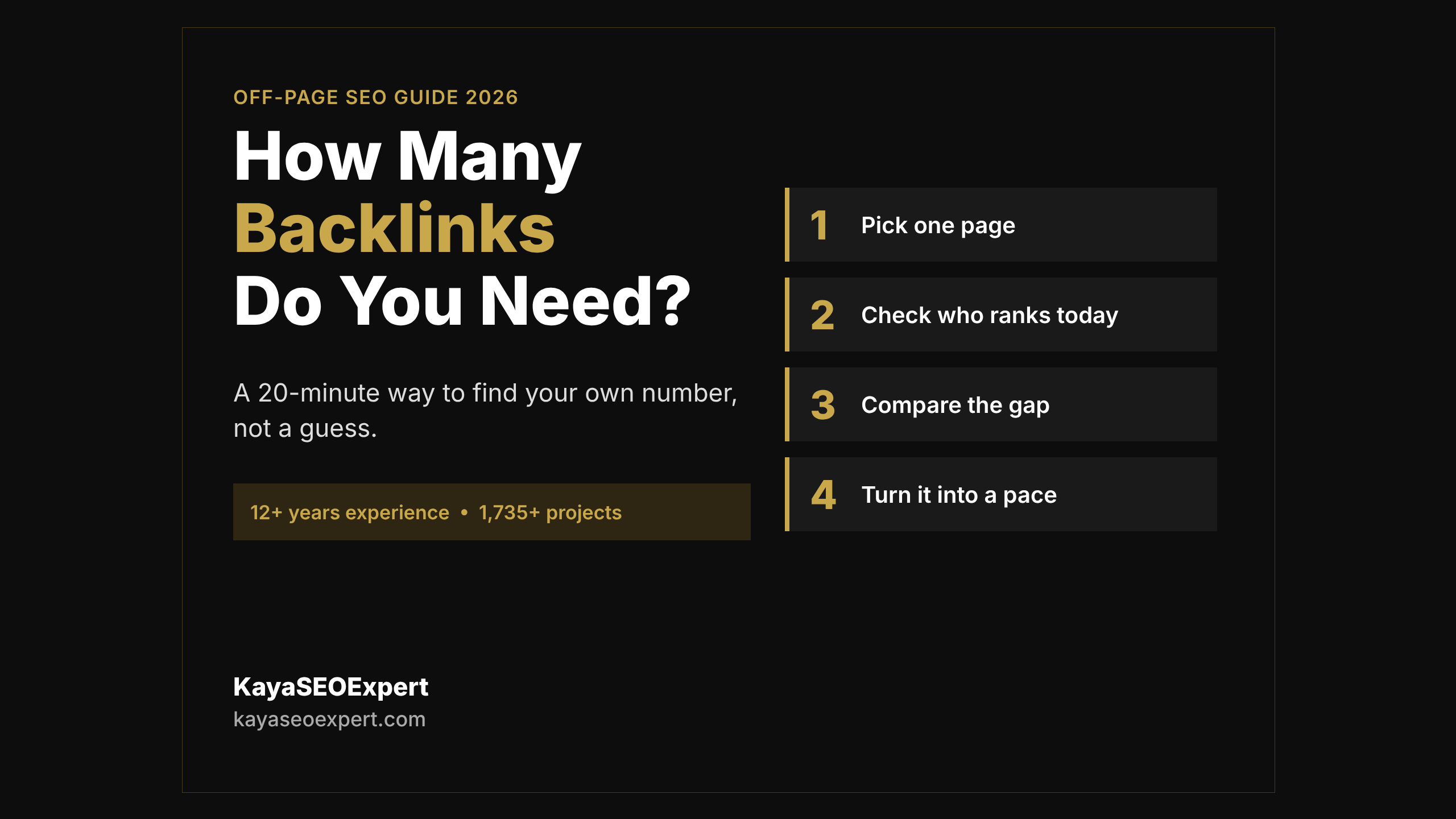
How many backlinks do I need? It is the first question almost everyone asks before they build a single link, and almost every answer online is either a vague “it depends” or a suspiciously exact number. This guide gives you something more useful: a repeatable method to work out your own number for one specific page, in about 20 minutes, using any backlink tool you already have.
Last updated: November 2026
I work on off-page SEO and link building full time, so the method below is the one I use when a client asks me how many links a page needs before we start. It does not promise rankings, because nobody can. It tells you how big the gap is, how fast to close it, and what to watch while you do.
The short answer: how many backlinks do I need?
There is no universal number. A page targeting a low-competition phrase may need a handful of good links, while a page targeting a crowded phrase may need dozens of links from different websites. The useful question is not “how many backlinks do I need?” but “how many more referring domains do I need than the pages already ranking above me?”
That gap is your number. Everything else in this article is about measuring it honestly and closing it at a pace that looks natural.
Why referring domains matter more than the backlink count
Three links from the same website are not three separate votes. Search engines and link tools mostly care about referring domains (how many different websites link to you) and how trusted those websites are. Ten links from ten relevant websites usually tell a stronger story than a hundred links from three.
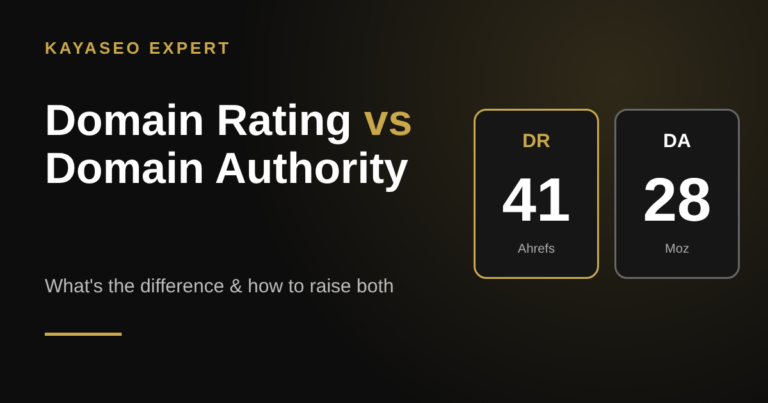
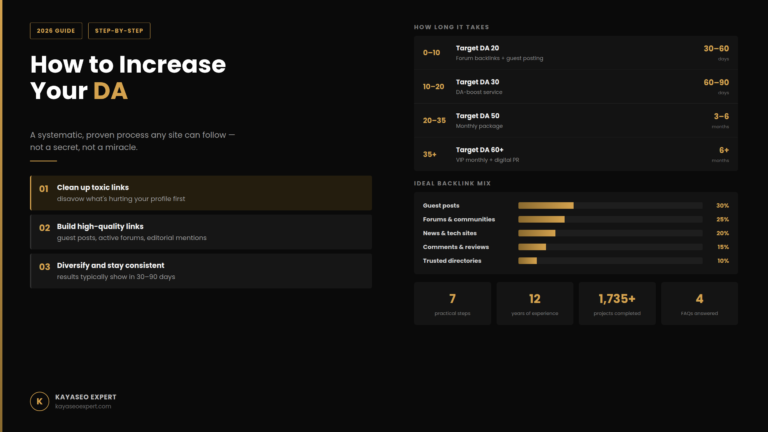
This is also the logic behind Ahrefs’ Domain Rating (DR) and Moz’s Domain Authority (DA). Both are third-party estimates of link strength built mostly on unique linking websites and the strength of those websites. They are not Google ranking factors, and they move on a curve: going from DR 10 to DR 20 is much easier than going from DR 50 to DR 60. If you want the full comparison, read our guide on the difference between DA and DR (Arabic) or how to increase your DA.
So when someone says “I have 500 backlinks”, the useful follow-up questions are: from how many domains, on how many different pages, and from which kinds of websites?
What decides how many backlinks you need
Four things move your number up or down. Look at them before you open any tool, because they explain why two pages with the same keyword difficulty can need very different numbers of links.
| Factor | Usually needs fewer links | Usually needs more links |
|---|---|---|
| Competition for the phrase | Few strong sites, mostly thin content | Brands and publishers with years of links |
| Your site’s existing authority | Already has links to other pages and some trust | New domain with almost no referring domains |
| Page type | Informational post with a narrow topic | Commercial or service page in a crowded market |
| Content and search intent match | Best answer on the results page | Weaker than the pages already ranking |
The last row matters more than most people admit. Links can help a page rank, but they cannot rescue a page that does not answer what searchers want. If your content is weaker than the pages above you, fix the page first, or you will spend your link budget lifting a page that cannot hold its position.
Step 1: Pick one page and one phrase
Backlinks help individual pages rank, so decide which page you want to move and for which phrase. A homepage, a service page and a blog post each have different needs, and mixing them gives you a meaningless average. Everything that follows answers how many backlinks do I need for that one page.
- Write down the exact URL you want to rank.
- Write down the exact phrase, and check that the page really targets it.
- Note the country and language of the results you care about. A phrase can be easy in one market and crowded in another.
Step 2: Audit who ranks today
Search your target phrase and open the top five organic results. For each one, open a backlink tool (Ahrefs, Semrush, Moz, or any other you use) and record the same fields in a simple sheet:
| Ranking position | Referring domains to that page | Referring domains to the whole site | Domain rating or authority | Content type |
|---|---|---|---|---|
| #1 | your data | your data | your data | your data |
| #2 | your data | your data | your data | your data |
| #3 | your data | your data | your data | your data |
| #4 | your data | your data | your data | your data |
| #5 | your data | your data | your data | your data |
Two rules keep this audit honest. First, ignore results that are huge brands or publishers; their rankings are not powered by the same things yours will be. Second, give more weight to the smaller or newer sites that rank, because they show you what is realistically needed to get there.
Different tools will show different totals for the same page, because each one runs its own crawler. That is normal. Use one tool consistently for every row so you are comparing like with like. If the numbers confuse you, our guide to backlink checker tools explains why they never match.
Step 3: Calculate your gap
Now check the same two numbers for your own page. Then take the median of the weaker results in your sheet (positions 3 to 5 are a good choice) and compare it to your page.
Hypothetical example, for illustration only: if your page has 3 referring domains and the pages at positions 3 to 5 have 12, 15 and 18, the median is 15. Your gap is about 12 referring domains. Because some links will never be counted, will be removed later, or will be nofollow, plan for roughly 20 to 30 percent more than the raw gap. That is a working buffer, not an official rule. In this example your target would be about 15 new referring domains, not 100 links.
So, how many backlinks do I need in this example? About 15 new referring domains, spread over several weeks, and only if the page deserves to rank.
Do the same check on the whole site. If the ranking sites have far more referring domains overall than you do, you may need to build site-level authority as well as page-level links. That is where a broader plan, such as a steady monthly build, makes more sense than one burst of links to a single page.
Step 4: Turn the gap into a pace
Backlinks look natural when they arrive gradually, from different sources, to different pages. A brand-new site that suddenly receives a large batch in one day stands out in a way that organic growth does not. A steady pace, spread over weeks, looks like normal growth and is also easier to monitor.
| Illustrative plan for 15 new domains | Links per week | What to check |
|---|---|---|
| Weeks 1 to 2 | 2 to 3 | Are the links live and indexed? |
| Weeks 3 to 5 | 2 to 3 | Anchor mix, pages receiving links |
| Weeks 6 to 8 | 2 to 3 | Referring domains in your tool, impressions in Search Console |
This schedule is an example of the shape, not a rule. A bigger gap means a longer plan, not a faster one. Spreading the work out also gives you time to react if a link is removed or a tool does not pick it up.
Step 5: Choose the right mix of links
Once you have answered how many backlinks do I need, the next question is which kinds of links to build. The same number of links can look very different depending on where they come from. A balanced profile usually includes several types, and the weights depend on your niche:
- Editorial and guest-post links from relevant websites. These are the hardest to earn and usually the most valuable. See our guest post guide (Arabic) for how they work.
- Resource pages and relevant directories where your page genuinely fits.
- Local citations if you are a local business. Our local link building guide covers how to keep your name, address and phone number consistent.
- Brand mentions turned into links, where someone already talks about you without linking.
- A small number of community links such as relevant forum or profile links, which support a natural profile but should not be the whole plan.
Anchor text deserves its own rule of thumb. There is no official ratio, so treat this as my working guideline: most anchors should be your brand name, the plain URL, or descriptive phrases, and exact-match keyword anchors should stay a small minority. If every link says the exact keyword, the profile looks engineered.
Step 6: Track results and adjust
Check progress once a month, not every day. Link tools update on their own schedule, so daily checks mostly measure noise. Each month, record:
- Referring domains to the target page and to the site, in the same tool you used for the audit.
- Whether each new link is live, on a real page, and indexed.
- Impressions, clicks and average position for the target phrase in Google Search Console.
- Any lost links, so you can replace them.
If referring domains rise but rankings do not move after a couple of months, go back to the content: is the page really the best answer for that phrase? If rankings rise, keep the same pace instead of rushing to add more. This is why “how many backlinks do I need” is never a one-off question: revisit it every quarter.
How many backlinks do I need for a DR target?
Many people ask this because they have a DR target (30, 40, 50) for a deal, a guest post requirement or a marketplace listing. A DR boost is simply a campaign that builds links from websites that Ahrefs counts, so your DR rises over time. If you are not sure how DR and DA differ, read Domain Rating vs Domain Authority first.
To give you a real reference point: in a local-business case study published on this site, a service business moved from DR 11 to DR 36 over five months while its main keyword went from page four to position three. Read the details in our local link building guide. Results like that depend on the starting profile, the niche and the quality of the work, so treat it as an example, not a benchmark you can expect.
Be careful with promises, whoever makes them:
- DR depends on your existing profile. A site with no links moves quickly at first, then slows down.
- Tools take time to discover links. Expect to check DR again after about 30 to 60 days.
- No service can guarantee an exact score, because the metric belongs to the tool, not to the service.
- A higher DR does not guarantee higher rankings. It is a rough sign of link strength.
If you want help planning one, see our DR boost service.
Different pages, different numbers
| Page type | What usually matters | Typical approach |
|---|---|---|
| Homepage | Brand strength and site-wide authority | Mix of brand-name links to build overall trust |
| Service page | Relevance and commercial competition | Fewer, more relevant links plus strong on-page content |
| Blog post | Search intent and uniqueness | Links to the post, supported by internal links from related posts |
| Local page | Consistent business details and local relevance | Local citations, local press and community links |
Common mistakes when deciding how many backlinks to build
- Counting links, not domains. 100 links from 3 websites is not the same as 100 links from 100 websites.
- One anchor text everywhere. Mix brand names, plain URLs and descriptive phrases.
- Pointing everything at the homepage. Support the pages you actually want to rank.
- Buying links in bulk without checking them. Check that each link is live and on a real page. Google’s spam policies on link spam explain which link practices it treats as manipulation, so read them before buying anything at scale.
- Copying a competitor’s total. Their number came with their history, brand and content. Use it as a clue, not a target.
- Expecting results in a week. Links need to be found, counted and then trusted.
- Ignoring the page itself. If the content does not satisfy searchers, extra links only delay the problem.
If you are starting from zero, begin with how to build backlinks for a new website, then come back to this method when you have your first links.
Final thoughts: how many backlinks do I need?
Your number is the gap between your page and the weaker pages that already rank, plus a buffer, built at a natural pace and checked every month. When you next ask yourself how many backlinks do I need, open your audit sheet instead of searching for a magic figure, and let the data answer.
Quick checklist
- I picked one page and one exact phrase, then asked how many backlinks do I need for that page only.
- I recorded referring domains for the top five results, using one tool.
- I calculated the gap using the median of positions 3 to 5.
- I added a buffer for lost or uncounted links.
- I spread the target over several weeks and several types of links.
- I kept exact-match anchors to a small minority.
- I set a monthly check for referring domains and Search Console data.
FAQ
How many backlinks do I need to rank on page one?
It depends on the phrase. Count the referring domains of the pages already on page one, aim to be close to the weaker ones, and make sure your content is at least as useful.
How many backlinks per month is safe?
There is no official limit. A gradual pace with varied sources and anchors looks natural, while large sudden batches to one page are easier to spot. Plan the pace around your gap rather than a fixed monthly quota.
Do nofollow links count?
They can still send visitors and make your profile look natural, but dofollow links from relevant websites usually matter more for authority metrics.
How long until I see a change?
Tools usually show changes within weeks, and rankings can take longer. Re-check after 30 to 60 days.
Does a higher DR mean higher rankings?
Not by itself. DR is a tool’s estimate of link strength. Rankings depend on many things, including content and search intent.
Is it better to build a few strong links or many weak ones?
A few relevant links from real websites usually say more than many low-quality ones. Quality and relevance come first, then volume at a natural pace.
Should I build links to the homepage or to inner pages?
Build links to the pages you want to rank, and let internal links pass some of that strength to related pages. A healthy profile still includes some links to the homepage.
Need a plan for your own site? Contact us and tell us your page and your target phrase.