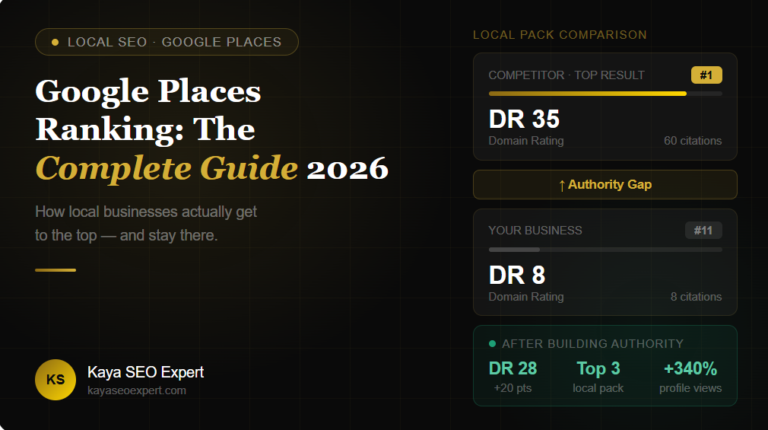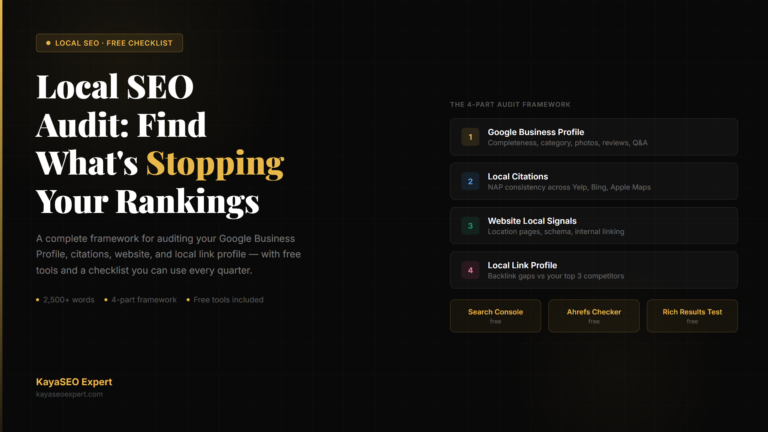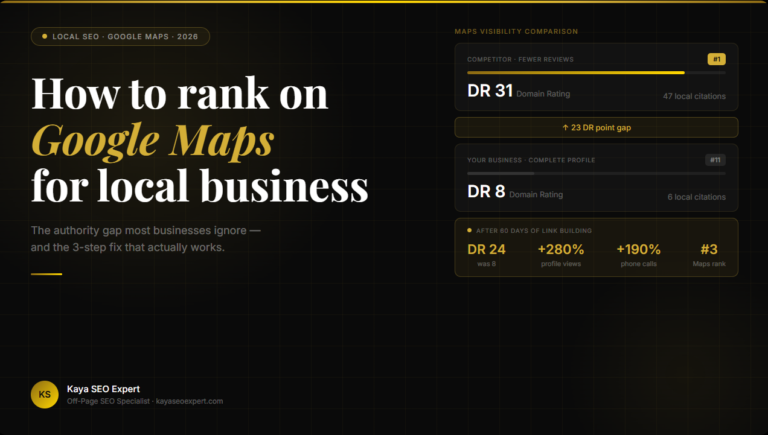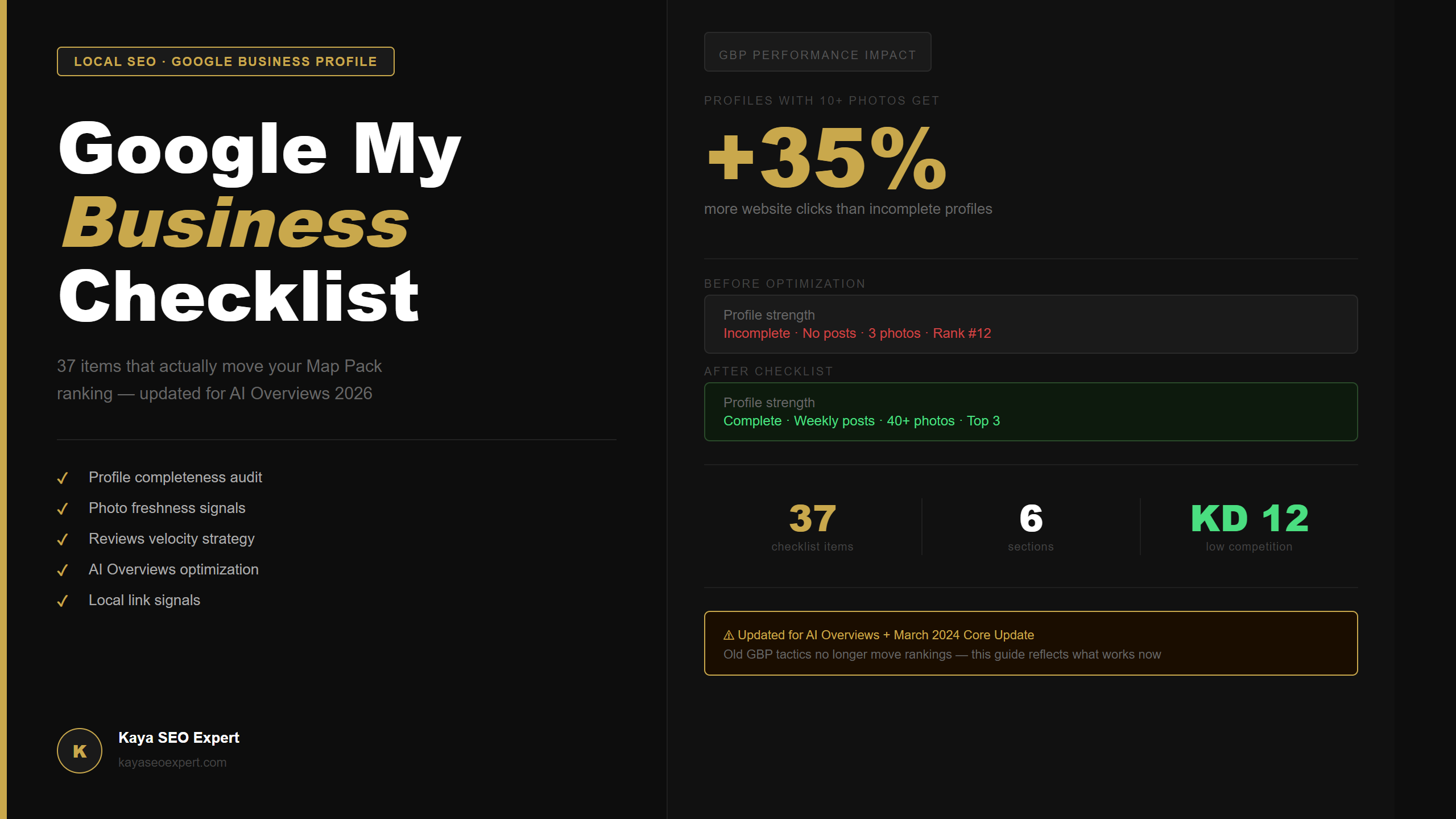
This google my business optimization checklist covers every signal that affects Map Pack rankings in 2026.from profile completeness and photo freshness to reviews, posts, and local link building.
A plumbing company in Dallas had a Google Business Profile. They had filled in their name, address, and phone number. They had a website link. They had been in business for eleven years.
Their competitor — open for three years, half the reviews, smaller service area — consistently appeared above them in the Map Pack.
The difference was not authority. It was not age. It was optimization depth.
When we audited the profile, the issues were immediate: no services listed, no photos added in eight months, no posts in the last ninety days, a description that said “professional plumbing services” and nothing else, and a Q&A section full of unanswered questions from potential customers.
The competitor had forty-seven photos, weekly posts, a description that named every neighborhood they served, and responses to every review within twenty-four hours.
Google’s local ranking algorithm in 2026 reads these signals continuously. A profile that sits static while competitors stay active is a profile that loses ground — even when the underlying business is stronger.
Before you use this checklist, it is worth understanding whether your profile problem is part of a larger local SEO issue. If your website gets traffic but no clients, a GBP audit is one piece of a larger puzzle worth examining.
This checklist covers every optimization layer that matters in 2026 — updated to account for AI Overviews, Google’s expanded GBP features, and the signals that have gained and lost weight since 2023.
Why GBP Optimization Changed in 2026
Google Business Profile is no longer a static directory listing. It has become a content platform, a review aggregator, a booking interface, and increasingly, a primary data source for AI Overviews.
Three changes matter most for optimization in 2026:
AI Overviews now pull from GBP data directly. When someone searches “best plumber near me” and an AI Overview appears, Google frequently pulls business details — hours, services, reviews — from GBP profiles. An incomplete or inactive profile means you are invisible in this new layer of search results, not just in the traditional map pack.
Photo freshness became a ranking signal. Google’s systems now evaluate not just whether you have photos, but how recently they were added. A profile with forty photos added two years ago performs worse than a profile with fifteen photos added in the last three months.
Service and product descriptions feed semantic relevance. Google uses the text in your services section to match your profile to relevant queries. A plumber who lists “emergency drain unclogging” as a service will appear for that query. One who lists only “plumbing” will not.
Understanding how your profile fits into the broader local ranking framework helps you prioritize which checklist items will have the most immediate impact for your specific situation.
Section 1: Profile Completeness Checklist
These are the foundational signals Google uses to evaluate whether your profile deserves to rank. Every unchecked item in this google my business optimization checklist is a ranking disadvantage.
☐ Business name matches your real-world name exactly Do not add keywords to your business name (e.g., “Mike’s Plumbing — Best Dallas Plumber”). This violates Google’s guidelines for representing your business and can result in suspension. Your GBP name should match the name on your storefront, website, and other directories exactly.
☐ Primary category is your most specific relevant option Most businesses default to broad categories. A personal injury law firm should select “Personal Injury Attorney” not just “Lawyer.” Search Google for competitors in your niche and note which primary categories they use — this is the fastest way to identify the most relevant option.
☐ Secondary categories cover your full service range You can add up to nine additional categories. A dentist might add: Cosmetic Dentist, Emergency Dental Service, Teeth Whitening Service, Dental Implants Provider. Each secondary category expands the queries your profile can appear for.
☐ Business description uses your core service keywords naturally The description field allows 750 characters. Use the first 250 characters for your most important information — this is what appears before “More” is clicked. Include your primary service, your location or service area, and what differentiates you. Avoid keyword stuffing; write for the reader first.
☐ Services section is complete with individual service descriptions This is one of the most underused features in GBP. Each service can have a name, description, and price. Write a 2-3 sentence description for every core service. These descriptions are indexed by Google and directly influence which queries your profile matches.
☐ Products section is populated (if applicable) For businesses that sell physical products, the Products section adds another layer of indexable content and can trigger product rich results in search.
☐ Hours are accurate and include special hours Incorrect hours are one of the fastest ways to damage your GBP ranking — Google monitors user behavior, and if people consistently find your business closed when your profile says open, it signals unreliable data.
☐ Phone number is local (not a tracking number as primary) Use a local area code number as your primary. Tracking numbers can be added as secondary numbers. Local numbers build NAP consistency across directories.
☐ Website URL points to the most relevant page For most businesses this is the homepage. For multi-location businesses, each location’s GBP should point to that location’s specific landing page.
☐ Attributes are fully selected Attributes include things like “women-owned,” “veteran-owned,” “wheelchair accessible,” “outdoor seating,” “free Wi-Fi,” and many more depending on your category. These appear as filters in local search and can surface your profile to users filtering by specific needs.
Run a full local SEO audit to identify which of these items need attention across your profile and your wider local presence.
The items above form the foundation of any solid google my business optimization checklist.
Section 2: Photos and Visual Optimization Checklist
Photos are one of the highest-impact GBP optimization levers available — and one of the most neglected after the initial profile setup.
☐ Logo photo is uploaded and current This appears next to your business name in search results and maps. Use a clean, high-resolution version against a white or transparent background.
☐ Cover photo represents your business clearly The cover photo is the first image most users see. It should show your storefront, your team, or your primary service in action — not a stock photo.
☐ At least 10 interior and exterior photos are present Profiles with more than ten photos receive significantly more direction requests and website clicks, according to Google’s own data.. Interior shots build trust; exterior shots help customers find you.
☐ Team photos are included People buy from people. Profiles that include photos of the business owner and team consistently outperform those that show only the location or products.
☐ New photos added at least twice per month This is the freshness signal that most businesses miss. Set a recurring calendar reminder to add two to three new photos every two weeks. These do not need to be professionally shot — authentic photos from your phone perform well.
☐ Photos are geotagged before upload Use a tool like GeoImgr to embed GPS coordinates in your photo metadata before uploading. This reinforces your location signal, particularly useful for businesses in competitive local markets.
☐ 360-degree photos or virtual tour added (if relevant) For restaurants, retail stores, salons, and other businesses where the interior environment matters to the customer decision, a virtual tour increases profile engagement and time spent — both positive signals.
Section 3: Reviews Strategy Checklist
Reviews influence local rankings directly through quantity, recency, and diversity of keywords used. They also influence click-through rate, which feeds back into rankings.
☐ Review response rate is 100% Respond to every review — positive and negative. Google has confirmed that responding to reviews is a ranking signal. For positive reviews, thank the customer and mention a specific detail from their experience. For negative reviews, acknowledge the issue, apologize, and offer to resolve it offline.
☐ Negative reviews are responded to within 24 hours A negative review with no response looks worse than a negative review with a professional, empathetic response. Speed matters — a slow response suggests the business does not monitor its reputation.
☐ Review request system is in place Businesses that proactively ask for reviews receive them at three to five times the rate of those that do not. Build a simple system: a follow-up text or email after service completion with a direct link to your GBP review page. Google provides a short URL for this purpose in your profile dashboard.
☐ Review keywords match your target services When customers leave reviews that mention specific services (“their emergency drain service was excellent”), it reinforces your profile’s relevance for those queries. Without being manipulative, you can prompt customers by mentioning the specific service name in your review request: “We’d love to hear about your experience with our drain cleaning service.”
☐ Review velocity is consistent Ten reviews in one week followed by three months of silence looks unnatural. A consistent pace of two to five reviews per month signals ongoing business activity and customer satisfaction.
Section 4: Posts and Updates Checklist
GBP Posts are time-stamped content updates that appear directly in your profile. They signal that your business is active and give Google fresh content to associate with your profile.
☐ At least one post published per week Weekly posts are the baseline for active profile signals. Posts expire after seven days for most post types, which means a business posting weekly always has fresh content visible.
☐ Post types are varied Use a mix of: What’s New posts (general updates), Offer posts (promotions with expiry dates), Event posts (for specific dates), and Product posts (to highlight specific offerings). Variety keeps the profile looking active across multiple content formats.
☐ Posts include a call to action Every post should have a CTA button: Call Now, Book, Learn More, Order Online, or Get Offer. Posts without CTAs generate less engagement and less trackable traffic.
☐ Posts reference local keywords naturally “We’re now offering emergency HVAC repair in the Plano and Frisco areas” is more useful than “We offer emergency repairs.” Geographic specificity in posts reinforces your local relevance signals.
For a deeper look at what local SEO packages should include around content and profile management, the breakdown of what actually works in local SEO packages in 2026 is worth reviewing before you decide how much of this to manage in-house versus outsource.
Section 5: Local Link Signals Checklist
Your GBP ranking is partly determined by factors outside the profile itself — specifically, the authority and relevance of your website and the consistency of your business information across the web.
☐ NAP is consistent across all directories NAP stands for Name, Address, Phone. If your business name appears as “Mike’s Plumbing” on Google, “Mikes Plumbing LLC” on Yelp, and “Mike’s Plumbing Services” on your website, Google treats these as potentially different entities. Audit your citations and standardize the format everywhere.
☐ At least 10 citation profiles are live Citations from directories like Yelp, Bing Places, Hotfrog, and industry-specific directories build the web of consistent business information that Google uses to verify your legitimacy. Aim for ten baseline citations before focusing on link quality.
☐ Website has a dedicated local landing page Your GBP links to your website — make sure the landing page that URL points to includes your city or service area, your primary keywords, and your NAP information in the footer. A weak landing page limits how much authority your GBP can transfer.
☐ Local backlinks are being built Links from local news sites, local business associations, chambers of commerce, and community organizations send the strongest local authority signals. Even a handful of genuinely local links outweigh dozens of generic directory links for local ranking purposes.
A structured approach to local link building built around your specific market is one of the highest-ROI activities for businesses trying to break into the top three of the Map Pack.
☐ Google Search Console is connected to your website This does not directly affect GBP rankings, but it gives you data on which queries are sending impressions to your website — data you can use to optimize your GBP description and services for the queries that are almost converting.
Section 6: Common Mistakes That Kill GBP Rankings
These are the mistakes that undermine even a well-executed google my business optimization checklist.
Keyword stuffing the business name. Adding “Best” or your service keyword to your business name is against Google’s guidelines. It can get your profile suspended. More importantly, it does not work — Google’s algorithm does not give ranking credit for keywords in the business name field.
Ignoring the Q&A section. The Questions and Answers section on your GBP profile is publicly editable — anyone can post a question, and anyone can answer it. Many business owners do not realize this and find their profile has inaccurate or unhelpful answers posted by random users. Monitor this section weekly and post your own questions with accurate answers to pre-empt common customer queries.
Setting and forgetting photos. A profile with photos that are eighteen months old sends a staleness signal. The algorithm cannot tell if your business is still active. Two new photos per month is the minimum to maintain a freshness signal.
Not using the service area feature correctly. If you serve customers at their location rather than at a fixed address, hide your address and use the service area feature instead. A business that shows an address but primarily serves customers remotely creates a mismatch signal that can hurt rankings.
Responding to reviews with copy-paste templates. Generic responses like “Thank you for your kind words! We appreciate your business!” appear automated and generate no engagement. Personalized responses that reference specific details from the review signal genuine customer relationships.
Not verifying ownership after a platform change. If your GBP was created years ago under a different email or by a marketing agency, make sure you have ownership access — not just manager access. Without ownership, you cannot fully control all profile settings and risk losing access if the relationship with that agency ends.
Google My Business Optimization Checklist: 2026 Priority Order
If you are starting from zero or a neglected profile, work through these in order:
Week 1: Complete all Section 1 items — profile completeness is the foundation everything else builds on.
Week 2: Upload at least fifteen photos across all categories. Add your logo and cover photo first.
Week 3: Build your review request system and send it to your last twenty customers.
Week 4: Write and schedule four GBP posts — one per week for the next month.
Month 2: Audit your NAP consistency across all directories. Build five to ten baseline citations.
Month 3 onward: Focus on local link building and maintaining post and photo freshness.
The businesses that consistently appear in the Map Pack are not doing anything exotic. They are doing these fundamentals at a higher level of consistency and detail than their competitors.
What to Do After the Checklist
A fully optimized GBP profile is the starting point — not the finish line. The profiles that dominate Map Pack results combine GBP optimization with a strong website, consistent local citations, and a genuine local backlink profile.
If you work through this checklist and your rankings do not move within sixty to ninety days, the constraint is almost certainly your website’s local authority or your backlink profile — not the profile itself. That is a different set of levers that requires a different approach.
Return to this google my business optimization checklist every quarter — Google updates its local ranking signals continuously, and what worked six months ago may need revision.
If you want a clear assessment of where your local SEO stands and a prioritized action plan based on your specific market and competition level, that is exactly the work done at kayaseoexpert.com.