You’re Doing Everything Right. So Why Isn’t Your Business Showing Up Locally?
A local SEO audit is the fastest way to find out exactly why your business isn’t showing up in local search results.
A plumbing company in Austin has a complete Google Business Profile, dozens of five-star reviews, and a website with location pages for every neighborhood they serve. Their owner checks Google every week, searching “plumber near me” from his phone, expecting to see his business in the local pack.
He doesn’t.
His competitor — with fewer reviews, a less polished website, and a profile that’s only “mostly” complete — shows up in position two, every time.
This scenario repeats itself thousands of times a day across every local industry imaginable. Business owners do the obvious things right and still don’t show up where it matters most: the local pack, the map results, the first page of local search.
The reason almost always comes down to one thing — nobody has actually audited what’s happening beneath the surface. Not a glance at the Google Business Profile. Not a quick check of the website. A real, systematic audit that looks at every signal Google uses to decide who deserves to rank locally.
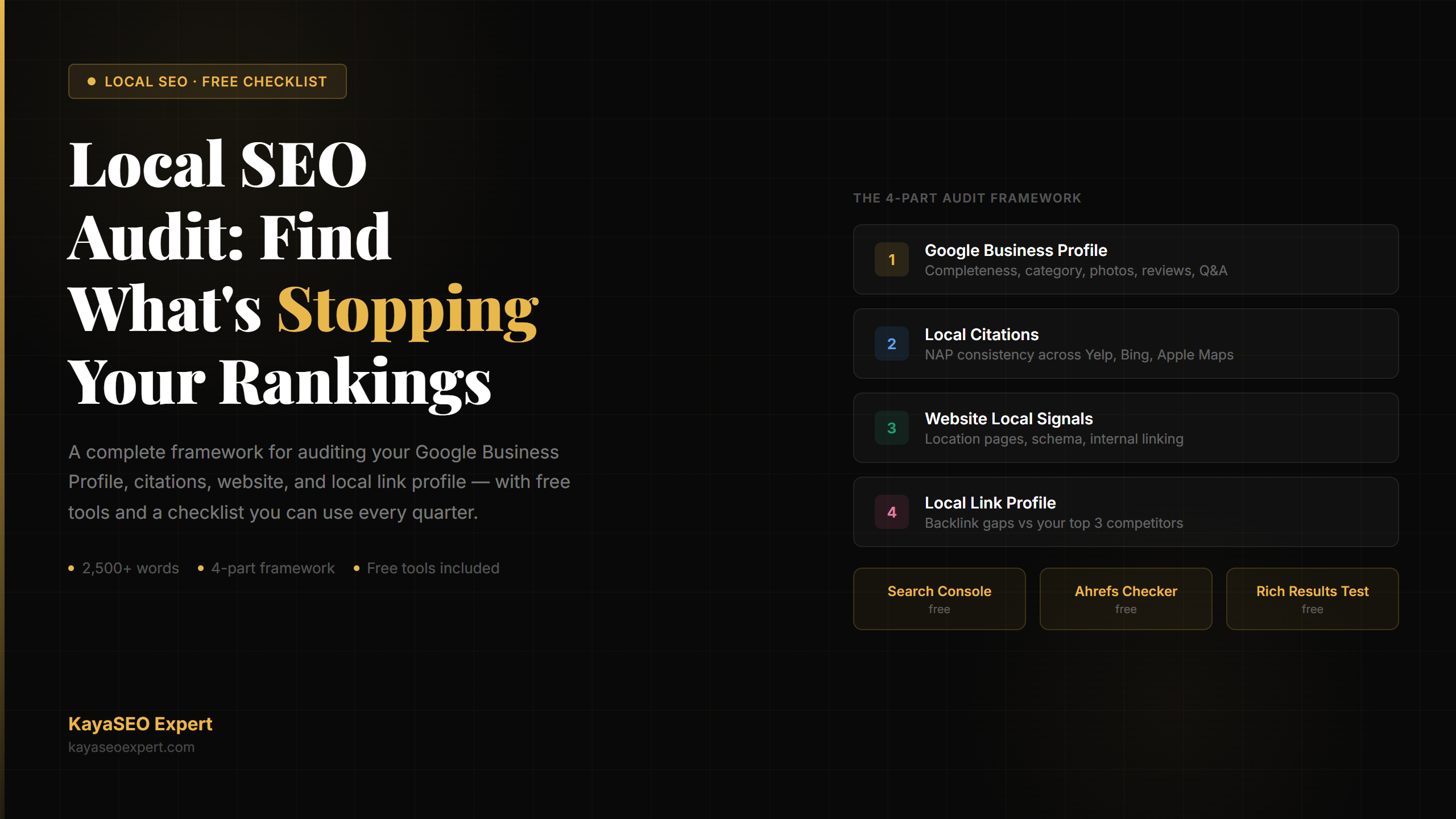
This guide walks through exactly how to do that audit yourself — covering your Google Business Profile, your citations, your website’s local relevance, and your local link profile. By the end, you’ll have a clear picture of what’s actually holding your rankings back, and a checklist you can return to every quarter.
If you’ve already noticed that your website gets visitors but those visitors never become clients, that’s often a related but separate issue — worth reading alongside this audit: Why Your Website Gets Traffic But No Clients.
What Is a Local SEO Audit, and Why Is It Different?
A standard SEO audit looks at things like site speed, technical errors, content quality, and backlink profiles — all important, but largely the same regardless of whether your business serves a global audience or a single neighborhood.
A local SEO audit adds an entirely different layer: the signals Google uses specifically to rank businesses for “near me” searches and map-based results. These signals include things a global SEO audit doesn’t typically touch — your Google Business Profile completeness, the consistency of your business name, address, and phone number (NAP) across the web, the proximity and relevance of your local citations, and whether your website content actually demonstrates local relevance to the areas you serve.
For a local business, these signals often matter more than traditional ranking factors. A locksmith with a technically perfect website but an incomplete Google Business Profile and inconsistent citations will frequently lose to a competitor with a mediocre website but pristine local signals.
This is why a local SEO audit needs its own framework — and why so many business owners who’ve “done SEO” still don’t show up locally. They optimized for the wrong layer.
Part 1 — Google Business Profile Audit
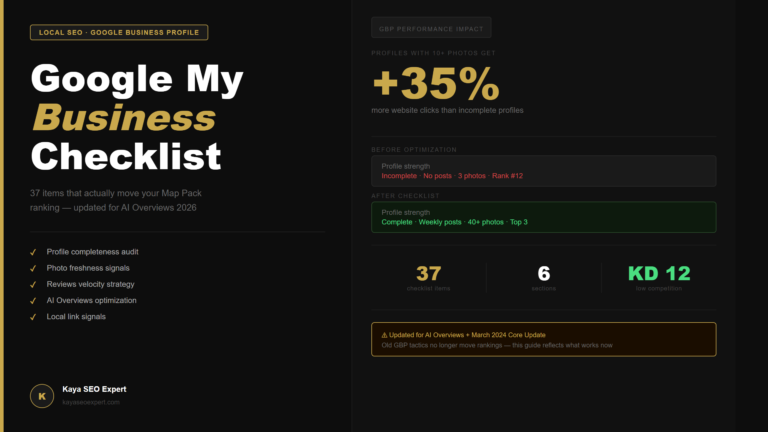
Your Google Business Profile (formerly Google My Business) is the single most influential factor in local pack rankings. Start here.
Check completeness first. Open your profile and go through every section: business name, primary and secondary categories, full address, service areas, hours (including special hours for holidays), phone number, website link, business description, and attributes (wheelchair accessible, women-led, etc.). Profiles with every section filled out consistently outperform partial profiles — Google rewards completeness because it signals an actively maintained business.
Audit your primary category. This is more important than most business owners realize. If you’re a “general contractor” but your primary category is set to “construction company,” you may be missing out on searches specifically for “general contractor near me.” Check what category your top three local competitors use, and make sure yours accurately reflects how customers search for you.
Review your photos. Profiles with regularly updated, high-quality photos get significantly more engagement. Audit when you last uploaded photos — if it’s been months, that’s a signal to Google (and to potential customers) that the business may not be active.
Check your review velocity and response rate. It’s not just about review count — it’s about whether reviews are coming in consistently over time, and whether you’re responding to them. A business with 50 reviews from two years ago and zero recent activity sends a different signal than a business with 50 reviews spread evenly over two years, with owner responses on each one.
Audit your Q&A section. This is one of the most overlooked parts of a Google Business Profile. Are there unanswered questions? Are there questions with incorrect answers from other users that you haven’t corrected? Each unanswered question is a missed opportunity to add relevant local keywords naturally while helping potential customers.
Check for duplicate listings. Search your business name and address on Google. If you find more than one listing — even an old, unclaimed one — this can split your local signals and confuse Google about which listing is authoritative. Duplicate listings need to be merged or removed.
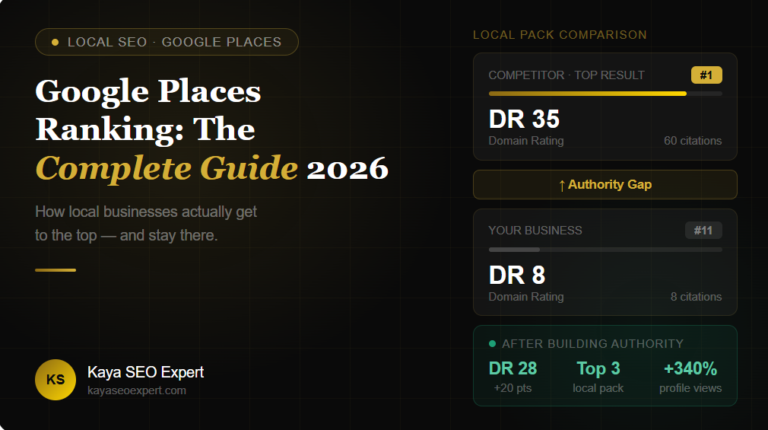
For a deeper look at how Google evaluates your business for map-based rankings specifically, this guide on Google Places ranking breaks down the algorithmic factors at play once your profile itself is in good shape.
Part 2 — Local Citations Audit
Citations are mentions of your business name, address, and phone number (NAP) on other websites — directories, industry associations, local chambers of commerce, and review platforms. Google uses citation consistency as a trust signal: if your NAP information matches across dozens of sources, it reinforces that your business is legitimate, established, and located where you say it is.
Run a NAP consistency check. Search your business name across major directories — Yelp, Bing Places, Apple Maps, Facebook, and any industry-specific directories relevant to your niche. For each one, check whether your name, address, and phone number exactly match your Google Business Profile. Even small discrepancies — “St.” versus “Street,” a suite number missing on one listing, an old phone number on another — can dilute the strength of this signal.
Identify your citation gaps. Look at where your top three local competitors are listed that you aren’t. Industry-specific directories are often the most valuable here — a roofing company listed on roofing industry directories sends a much stronger relevance signal than a generic business directory listing.
Audit for outdated information. If your business has moved, changed its phone number, or rebranded in the past few years, old citations with outdated information may still exist. These don’t just fail to help — they can actively create confusion in Google’s understanding of your business’s current location and identity.
Prioritize quality over quantity. A handful of citations on authoritative, relevant directories will do more for your local rankings than dozens of citations on low-quality, generic directory sites that exist purely to sell citation packages. If you’re investing time in building new citations, focus on platforms that are genuinely used by people in your industry or local area.
Part 3 — Website Local SEO Audit
Your Google Business Profile and citations tell Google where you are and that you’re legitimate. Your website needs to tell Google — and your visitors — what you do, where you do it, and why you’re relevant to local searches.
Audit your location pages. If you serve multiple areas, does each area have its own dedicated page with genuinely unique content — not just the same template with the city name swapped out? Thin, templated location pages are one of the most common reasons local businesses fail to rank for searches in specific neighborhoods or suburbs.
Check your title tags and meta descriptions for local relevance. Do your most important pages include your service area naturally in the title tag? “Emergency Plumbing Services in [City]” tells Google and searchers immediately what the page is about and where it applies. A generic “Emergency Plumbing Services” with no location signal leaves Google guessing.
Audit your schema markup. LocalBusiness schema markup helps Google understand your business details in a structured way — address, phone number, hours, service area, and more. Many local business websites either have no schema markup at all or have outdated/incorrect information in their schema that contradicts what’s on the page or in their Google Business Profile.
Check for NAP consistency on your own website. It sounds obvious, but it’s surprisingly common for a business’s footer to show one phone number while the contact page shows another, or for an old address to still appear somewhere on the site after a move. Audit every page where your NAP appears.
Review your internal linking for local relevance. Does your blog content link to relevant location or service pages? If you write a blog post about “signs you need a water heater replacement,” does it link to your water heater repair service page for the relevant city? This kind of internal linking helps distribute relevance signals to the pages that need to rank locally.
The content on your local pages matters as much as their technical structure. Applying current SEO page content best practices ensures your location pages satisfy both Google’s quality signals and your visitors’ intent — covered in detail in the guide to SEO page content best practices 2026.
If your audit reveals that your local pages are technically sound but you’re still not showing up against competitors, the gap is often in the next section — your local link profile.
Part 4 — Local Link Profile Audit
This is the part of a local SEO audit that gets skipped most often — and it’s frequently the actual reason a business with a perfect Google Business Profile and solid website still doesn’t outrank competitors.
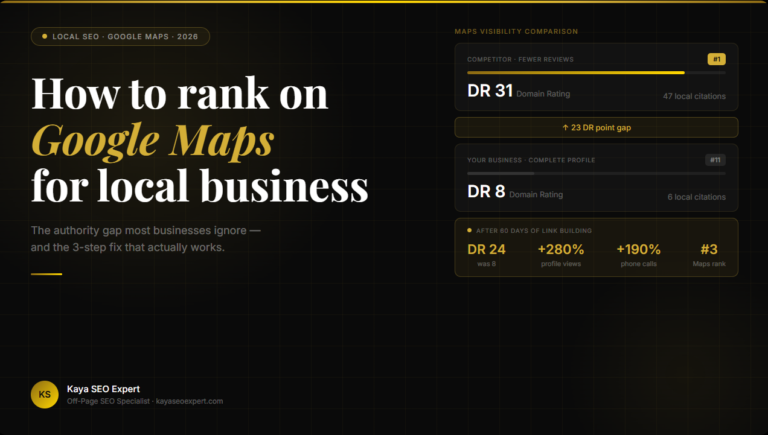
Check your overall backlink count and Domain Rating. Use a free tool to check your domain’s current backlink profile and compare it directly against your top three local competitors. If there’s a significant gap — your competitor has dozens of referring domains and you have a handful — this is often the single biggest factor separating your rankings.
Audit for local relevance in your existing links. Not all backlinks are equal for local SEO. A link from a local newspaper, a local business association, a sponsorship page for a community event, or a partner business in your area carries more local relevance than a generic link from an unrelated national site. Go through your existing backlinks and identify how many come from sources with genuine local or industry relevance.
Identify where your competitors are getting local links that you’re not. This is often the most actionable part of the audit. Check your top-ranking local competitors’ backlink profiles for patterns — are they sponsoring local events? Listed on local business association sites? Featured in local news coverage? These patterns often reveal replicable opportunities.
Look for unlinked mentions of your business. Sometimes your business is mentioned on local websites — in a news article, a community page, a partner’s site — without a link back to your website. These unlinked mentions are often easy wins; a polite outreach email asking the site owner to add a link can convert a mention into a genuine backlink.
For a complete framework on building local links systematically — not just auditing what exists — this guide on link building for local businesses covers the specific tactics that work best once you know where your gaps are.
Free Tools for running this local SEO audit Yourself
You don’t need an expensive software subscription to run a meaningful local SEO audit. Here are tools that cover each section above:
For Google Business Profile and local pack visibility: Google’s own Search Console shows you which local queries your website is appearing for and at what position — essential for understanding your current baseline before making changes.
For backlink and Domain Rating analysis: Ahrefs’ free backlink checker gives you your Domain Rating, total backlinks, and referring domains, and lets you run the same check on up to competitors for direct comparison — exactly what Part 4 of this audit requires.
For citation consistency: Manually searching your business name on Yelp, Bing Places, Apple Maps, and Facebook takes time but costs nothing, and gives you a direct view of how your NAP appears across the platforms that matter most.
For schema markup validation: Google’s Rich Results Test lets you paste any URL and see exactly what structured data Google can read from your page — useful for catching schema errors quickly.
None of these require payment to get the data you need for a thorough first-pass audit. The goal isn’t to buy tools — it’s to systematically go through each section above and document what you find.
Your Local SEO Audit Checklist
Use this local SEO audit checklist every quarter — work through it section by section, and revisit quarterly:
Google Business Profile
Every profile section is complete (categories, hours, attributes, description)
Primary category matches how customers actually search for your business
Photos uploaded within the last 30 days
All recent reviews have owner responses
Q&A section reviewed and corrected
No duplicate listings exist
Local Citations
NAP matches exactly across Yelp, Bing Places, Apple Maps, Facebook
Identified citation gaps compared to top 3 competitors
Outdated citations from old addresses/numbers corrected or removed
New citations prioritized on industry-relevant directories
Website
Each service area has a unique, non-templated location page
Title tags and meta descriptions include natural local signals
LocalBusiness schema markup present and accurate
NAP consistent across every page on the website
Blog content links internally to relevant local service pages
Local Link Profile
Backlink count and Domain Rating compared against top 3 competitors
Existing backlinks audited for local/industry relevance
Competitor link sources identified for replicable opportunities
Unlinked brand mentions identified for outreach
What to Do With What You Find
A local SEO audit isn’t useful as a one-time exercise — it’s useful as a recurring diagnostic that tells you where to focus your time and budget next.
If your audit reveals that your Google Business Profile and citations are strong but your link profile is significantly behind your competitors, that’s a clear signal: your next investment should go toward local link building, not more profile optimization.
If your website lacks dedicated location pages or your schema markup is missing entirely, those are often quick technical fixes that can unlock visibility you’re currently leaving on the table — independent of any link building work.
And if you find that visitors are reaching your site through local searches but not converting into actual clients or calls, the issue may not be visibility at all — it may be what happens after someone lands on your page, which is a different diagnostic covered in Why Your Website Gets Traffic But No Clients.
The businesses that consistently show up in local search results aren’t necessarily the ones with the biggest budgets. They’re the ones who’ve systematically addressed every signal Google looks at — and who revisit that audit regularly as their business, their competitors, and Google’s algorithm all continue to evolve.
If you’ve run through this audit and found gaps you’re not sure how to prioritize or fix — particularly around local link building, which is often the most time-consuming part to address — that’s exactly the kind of work I help local businesses with. You can reach out at kayaseoexpert.com and I’ll walk through your specific audit results with you.