If you’re struggling with Google Places ranking, you’re not alone. You’ve claimed your Google Business Profile, added photos, responded to reviews, and filled in every field. You’ve done everything the guides told you to do.
But when someone searches for your business category in your city, your competitors show up in Google Places. You don’t.
Here’s what most guides miss: Google Places ranking isn’t decided by your Business Profile alone. It’s decided by the total authority of your online presence — and most local businesses focus entirely on the wrong thing.
This guide covers exactly how Google Places ranking works in 2026, what separates the businesses appearing in the local pack from the ones that don’t, and the step-by-step process to get your business there.
What Is Google Places — And How Is It Different From Google Maps?
Most people use “Google Places” and “Google Maps” interchangeably — but they’re not the same thing, and the distinction matters for your ranking strategy.
Google Maps is the navigation application — the tool people use to get directions, explore areas, and discover businesses while physically moving around a location.
Google Places refers specifically to the local business listings that appear in Google Search results — the “local pack” or “map pack” that shows up when someone searches for a business category in a specific area. This is the box of 3 results that appears at the top of the search results page, above the organic listings.
This distinction matters because:
- Google Maps rankings and Google Places (local pack) rankings use the same underlying algorithm but display differently
- The local pack appears in regular Google Search — meaning your Places ranking affects visibility for anyone searching on desktop or mobile, not just people using the Maps app
- Optimizing for Google Places means optimizing for regular Google Search results — which is where the majority of local business searches happen
When someone searches “plumber near me” or “best Italian restaurant in [city]” — the three businesses that appear in the local pack before the organic results are winning on Google Places. That’s the position this guide is designed to help you reach.
How Google Places Ranking Actually Works in 2026
Google uses three core factors to determine which businesses appear in the local pack. Understanding each one — and knowing which you can actually influence — is the foundation of any effective local ranking strategy.
Factor 1: Relevance
Relevance answers the question: does this business match what the person is searching for?
Google determines relevance through:
- Your primary and secondary business categories in Google Business Profile
- Keywords in your business description
- Services and products listed in your profile
- Keywords that appear in your reviews
- The content of your website and how it relates to the search query
Most businesses handle relevance reasonably well — they fill in their categories and write a description. The problem is that every competitor in your market has also done this. Relevance alone doesn’t differentiate you.
Factor 2: Distance
Distance answers the question: how close is this business to the person searching?
This factor is largely outside your control. Google calculates distance based on your verified business address relative to the searcher’s location or the location specified in the search query.
The one thing you can influence here: make sure your address is verified correctly in Google Business Profile and is consistent everywhere it appears online. Inconsistent address information — different formats, wrong zip codes, outdated locations — creates confusion signals that hurt your local ranking.
Factor 3: Prominence — Where the Real Competition Happens
Prominence answers the question: how well-known and trusted is this business online?
This is where most local businesses lose their Google Places ranking — and it’s where the real work happens.
Google measures prominence through:
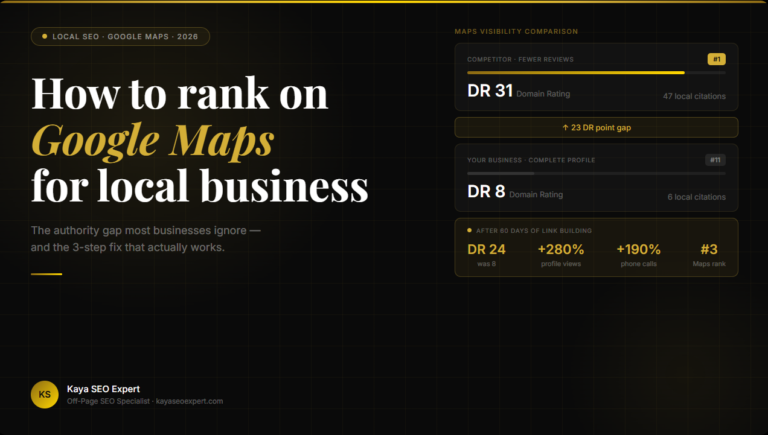
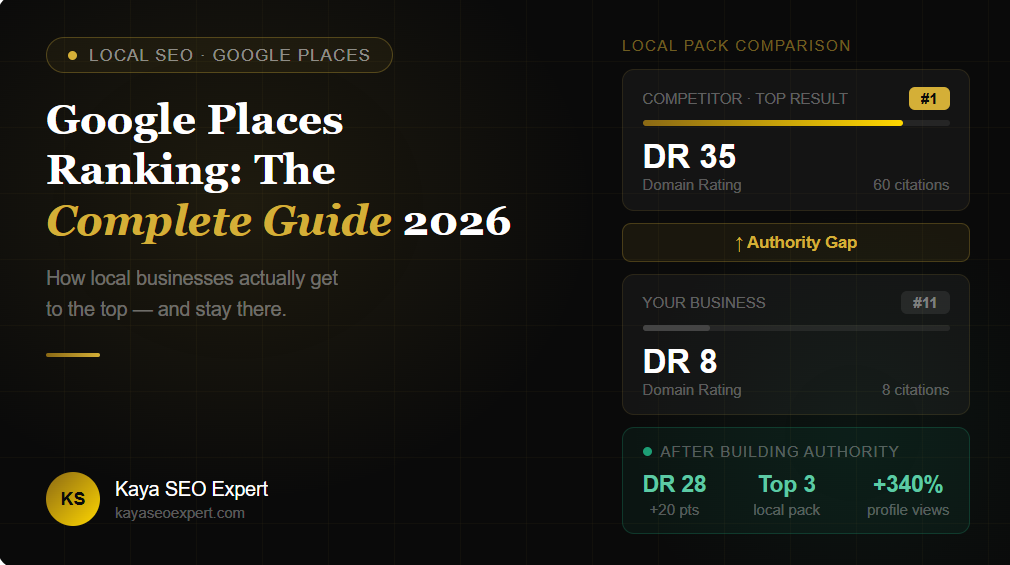
Website Domain Rating (DR): The overall authority of your website based on the quality and quantity of other websites linking to it. A business with a DR of 35 will almost always outrank a business with a DR of 8, even if the DR 8 business has a more complete profile and more reviews.
Local Citations: Mentions of your business name, address, and phone number (NAP) across the web — directories, review sites, industry platforms, local websites. More consistent citations signal to Google that your business is established and legitimate.
Backlinks: Links from other websites pointing to your website. A link from a local news site or industry directory tells Google that credible sources recognize your business as relevant and trustworthy.
Review Quantity and Recency: The number of reviews and how recently they were posted. A business with 200 reviews accumulated over 5 years may perform worse than one with 50 reviews posted in the last 6 months.
Engagement Signals: Click-through rates, direction requests, phone calls made through the listing, and time spent on your website all contribute to prominence signals.
Of these factors, DR and citations are the two that most local businesses completely ignore — and they’re the two that most directly determine whether you appear in the local pack.
The Google Places Ranking Gap: Why Your Competitor Outranks You
Let’s be specific about what the ranking gap looks like in practice.
When a business appears in position #1 in the local pack for a competitive search, that business almost always has:
- A website DR between 25-50 (depending on market competitiveness)
- 40-80+ local citations with consistent NAP information
- At least 5-10 backlinks from locally or topically relevant websites
- Reviews posted within the last 30-60 days
When a business is stuck at position #8-15 — visible in the extended local results but not in the featured pack — that business typically has:
- A website DR between 5-15
- Fewer than 30 citations, often with inconsistent NAP
- Few or no backlinks from relevant local sources
- Reviews that are clustered in a past period with little recent activity
The gap in Google Places ranking between these two positions isn’t about the quality of the business or even the completeness of the Google Business Profile. It’s almost entirely about the accumulated online authority of the business website and its local citation footprint.
To understand the full picture of how backlinks affect local business visibility, the complete strategy is covered here: Effective Link Building for Local Business in 2026
Step 1: Diagnose Your Current Google Places Ranking Position
Before building anything, you need to know exactly where you stand.
Check Your Current Local Pack Position
Search for your main business category + your city on Google. Note your position. If you’re not in the top 3, you’re not in the featured local pack — but you may be in the extended results.
Important: Search results are personalized. Use an incognito window or a tool like BrightLocal’s Local Search Grid to get an unbiased view of your actual position.
Check Your Website DR
Go to Ahrefs Webmaster Tools (free with account verification) or use the free Moz Domain Authority checker. Note your current score.
Then check the DR of the businesses ranking in positions #1, #2, and #3 for your main search term. The difference between their DR and yours is your authority gap — and it tells you how much work is ahead.
Check Your Citation Count
Use BrightLocal or Whitespark’s Citation Finder (both have free options) to see how many citations your business currently has. Compare this with the citation count of your top-ranking competitors.
Check Your Review Velocity
Look at when your reviews were posted. If most of your reviews are older than 6 months, Google may be discounting their freshness signal. Review velocity — how frequently you’re receiving new reviews — matters as much as total review count.
Step 2: Build Your Local Citation Foundation
Citations are the baseline of any serious Google Places ranking strategy — without them, everything else delivers diminished returns.
The Citation Building Sequence
Phase 1 — Core Platforms (Complete First)
Every local business needs consistent NAP information on these platforms before anything else:
- Google Business Profile (primary — verified)
- Bing Places for Business
- Apple Maps (via Apple Maps Connect)
- Facebook Business Page
- Yelp
- Foursquare / Swarm
- Better Business Bureau
- Chamber of Commerce (local chapter)
- Yellow Pages
- Nextdoor Business
Phase 2 — Industry-Specific Directories
After the core platforms, move to directories specific to your industry. A dental practice should be on Healthgrades, Zocdoc, and the American Dental Association directory. A restaurant should be on OpenTable, Zomato, and TripAdvisor. A contractor should be on Angi (formerly Angie’s List), HomeAdvisor, and Houzz.
The specificity of these citations matters. Google understands industry context — a link from a dental directory to a dental practice carries more local relevance weight than a generic business directory listing.
Phase 3 — Local and Regional Directories
City-specific directories, regional business associations, local newspaper business listings, and community organization directories. These carry geographic relevance that generic national directories don’t.
The NAP Consistency Rule
Your business name, address, and phone number must be identical across every citation — not just similar. “St.” and “Street” are different. “Suite 4” and “#4” are different. “LLC” included or excluded is different.
Choose one format for each element and use it consistently everywhere. Even minor inconsistencies create conflicting signals that reduce the effectiveness of your citation footprint.
Target: 40-60 consistent citations before moving to backlink building. In less competitive markets, this alone can move a business from position 12 to position 5-6.
Step 3: Build Local Backlinks That Actually Move Rankings
This is where most local businesses stop — because they don’t know how to get backlinks, or they think it’s too technical or expensive.
Local backlinks are actually easier to acquire than most people think. They require relationships and effort, not technical expertise.
The Most Effective Local Backlink Sources
Local News and Media Coverage
A single link from a local newspaper or news website can have more impact on your Google Places ranking than 20 generic directory listings. Local news sites have strong geographic authority — Google specifically recognizes them as relevant signals for local rankings.
How to get local press coverage:
- Issue a press release for genuinely newsworthy events — opening, expansion, major milestones, community involvement
- Offer to be quoted as an expert source on stories relevant to your industry
- Sponsor local events that generate coverage
- Write opinion pieces or expert columns for local publications
Event Sponsorships
Local events — charity runs, school fundraisers, community festivals, sports teams — almost always include a sponsors page on their website with links to sponsor businesses. These links are geographically highly relevant and easy to acquire.
The investment is often small relative to the SEO value: sponsoring a local little league team for a few hundred dollars may get you a link from a domain that’s been accumulating local authority for years.
Local Business Partnerships
Businesses that serve similar customers but aren’t direct competitors are natural link partners. A wedding photographer can link to a florist. A personal trainer can link to a nutritionist. A plumber can link to a general contractor.
These mutual mentions are natural, editorially justified, and geographically relevant — exactly what Google’s local algorithm rewards.
Chamber of Commerce and Business Associations
Most chamber of commerce memberships include a listing in the member directory with a link to your website. Local business improvement districts, trade associations, and professional organizations work the same way.
These are among the easiest local backlinks to acquire — the link comes with your membership.
Guest Content on Local Platforms
Writing a useful article for a local blog, contributing to a community newsletter, or being featured in a local business spotlight all generate backlinks while also building your local visibility and reputation.
For businesses serving an e-commerce audience in addition to local customers, the link building approach needs to account for both local relevance and commercial intent: Ecommerce Link Building: Complete Guide 2026
Step 4: Optimize Your Google Business Profile for 2026
Profile optimization won’t overcome a weak authority profile — but once your citations and DR are competitive, profile optimization becomes the tiebreaker.
Primary Category Selection
Your primary category is the single most important element of your profile. Choose the most specific category that accurately describes your core business. “Italian Restaurant” outperforms “Restaurant” for relevant searches. “Emergency Plumber” outperforms “Plumber” for emergency searches.
Secondary Categories
Add all relevant secondary categories. If you’re a law firm that handles both personal injury and estate planning, add both as secondary categories. Each category you add opens up additional relevant searches.
Business Description
Your business description should naturally include your primary keyword and describe what makes your business the best choice for your specific customer. It should read naturally — not as a keyword list.
The description doesn’t have a direct ranking influence, but it affects click-through rate — which does influence ranking as a behavioral signal.
Photos and Updates
Businesses with recent photos and regular Google Posts consistently outperform those with static, outdated profiles. Google interprets activity as a signal that the business is operational and engaged.
Post at minimum:
- One new photo per week (exterior, interior, team, products, work samples)
- One Google Post per month (offer, event, update, or news)
Review Management
Getting reviews: The most effective approach is to ask immediately after a positive interaction. The request should be direct and personal — “Would you be willing to leave us a Google review? It really helps.” Include a direct link to your review page.
Responding to reviews: Respond to every review — positive and negative. For positive reviews, thank the customer and mention a specific detail from their review. For negative reviews, acknowledge the concern, apologize where appropriate, and offer to resolve it offline.
Review response behavior is an engagement signal. Businesses that actively manage their reviews show Google that the listing is monitored and maintained.
Step 5: Track Your Google Places Ranking Progress
Without tracking, you can’t know what’s working. These are the metrics that matter:
Google Business Profile Insights:
- Profile views (how many people saw your listing)
- Direction requests (high-intent signal)
- Phone calls (conversion signal)
- Website clicks
Google Search Console: Track impressions and clicks for local keywords. As your Google Places ranking improves, you’ll see impressions for local queries increase before clicks do.
Local Rank Tracking: BrightLocal and Local Viking both offer local rank tracking tools that show your position in the local pack across different search locations within your service area.
Domain Rating Progress: Check your DR monthly using Ahrefs Webmaster Tools. DR growth is slow and gradual — moving from DR 8 to DR 20 might take 4-6 months of consistent link building. But each point of improvement compounds.
Google Places Ranking Timeline: What to Expect
Realistic expectations prevent the most common mistake in local SEO — stopping before the results arrive.
Month 1-2: Foundation Citation building, profile optimization, first local backlinks. No visible ranking changes yet. Google is processing the new signals.
Month 3-4: Early Movement Extended local results positions begin to improve. Some keywords move from page 2 to the bottom of page 1. DR starts to move.
Month 5-6: Local Pack Entry For less competitive searches, first appearances in the local pack. Profile views and direction requests begin to increase.
Month 7-12: Competitive Position For moderately competitive markets, consistent local pack presence. For highly competitive markets, continued improvement with local pack for longer-tail searches.
The businesses that reach and maintain top-3 Google Places positions are almost always the ones that stayed consistent through months 3 and 4 — when there’s effort but no visible results yet.
Common Google Places Ranking Mistakes
Optimizing the profile before building authority A perfectly optimized Google Business Profile attached to a DR 5 website will not outrank a mediocre profile attached to a DR 35 website. Authority first, optimization second.
Inconsistent NAP across citations Every inconsistency reduces the signal strength of your citation footprint. Audit your existing citations before building new ones.
Buying fake reviews Google detects review patterns. Sudden spikes in reviews, reviews from accounts with no history, and reviews that don’t match the writing style of real customers all trigger algorithmic filtering. Fake reviews can result in review removal or listing suspension.
Ignoring review velocity A business with 200 reviews from 3 years ago is losing to a business with 40 reviews from the last 6 months in many markets. Recency matters.
Building links too fast Acquiring 30 backlinks in a single month looks unnatural. Google’s spam detection flags velocity spikes. Build 4-8 quality local backlinks per month — consistent and gradual.
Only building homepage links Links should point to your most important pages — service pages, location pages, and the homepage. Concentrating all links on one page creates an unnatural profile.
What to Do Right Now
If your business isn’t appearing in the Google Places local pack, improving your Google Places ranking starts with an honest audit of your authority gap — then the path forward is clear:
- Audit your authority gap — check your DR vs. the top 3 businesses in your market
- Audit your citation consistency — find and fix inconsistent NAP information
- Build citations systematically — core platforms first, then industry and local directories
- Acquire 4-6 local backlinks per month — news, events, partnerships, associations
- Optimize your profile — categories, description, photos, review management
- Track and adjust monthly — rankings, DR, profile insights
Want to know exactly where you stand?
Visit kayaseoexpert.com for a free backlink and citation analysis. I’ll review your current DR, compare it to the businesses outranking you, and tell you exactly what needs to be built to reach the local pack.
No pitch. No package. A straight answer about your current position and the realistic path to the top 3.
Written by Kaya SEO Expert — Off-Page SEO Specialist helping local businesses build the authority needed to rank in Google Places and Google Maps. Weekly insights at kayaseoexpert.com