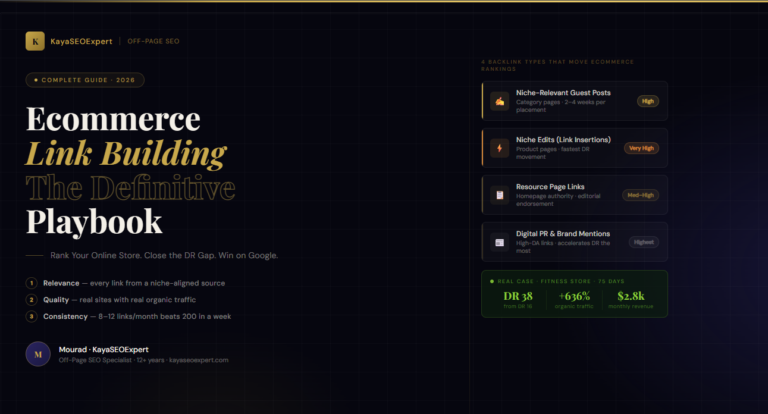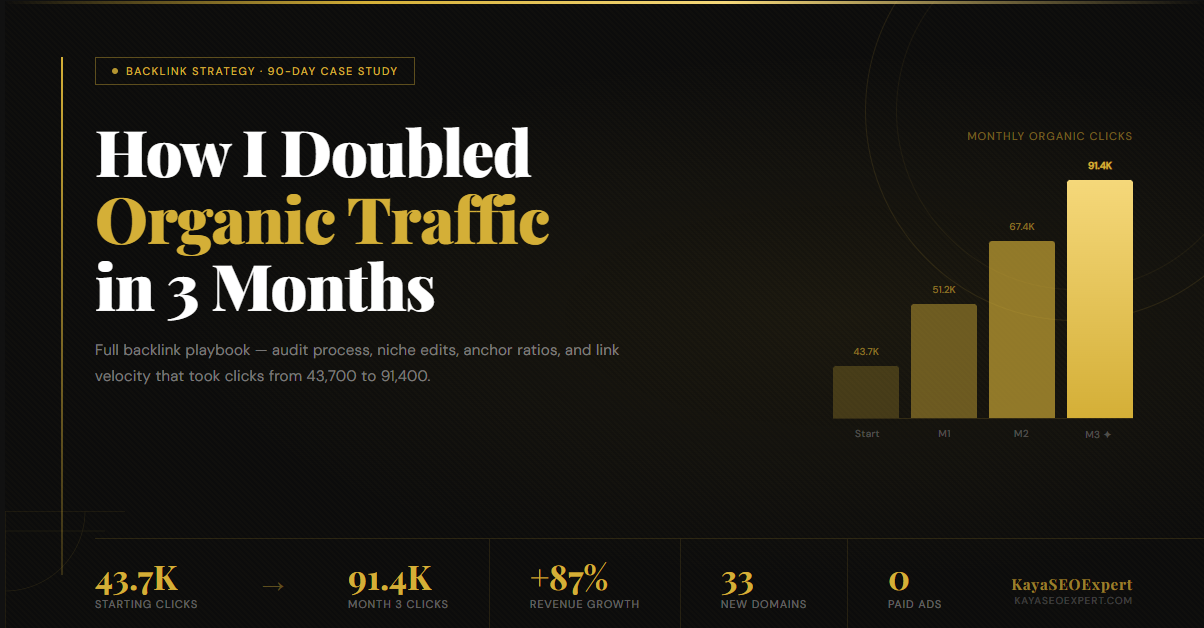
This ecommerce backlink strategy 2026 took a store from 43,700
to 91,400 organic clicks per month — in just 3 months.
No paid ads. No viral content. No lucky algorithm boost.
The only variable that changed was the backlink strategy. In this guide, I’m going to show you exactly what I did — the audit process, the link types I used, the anchor text ratios I followed, and the results at every stage. No fluff. Just the full playbook.
Why Most E-Commerce Backlink Strategies Fail Before They Start
Most store owners approach link building the same way: find a service, pay for a package, wait for rankings to improve. When nothing happens, they assume backlinks don’t work.
Backlinks work. The strategy doesn’t.
Here’s the core problem: Google in 2026 doesn’t count links — it reads patterns. A sudden spike of 200 links from low-traffic, unrelated websites doesn’t look like authority. It looks like manipulation. And Google’s spam filters are built specifically to neutralize exactly that pattern.
The stores that win in organic search aren’t buying link packages. They’re building a structured, relevance-first backlink profile — slowly, consistently, and with clear quality filters.
That’s the entire difference.
For a deeper look at why cheap backlink services actively hurt rankings rather than help them, I covered the full breakdown in the Ecommerce Link Building Guide.
Step 1: Audit Before You Build Anything
Step 1 of any ecommerce backlink strategy 2026 starts with a full audit.The first thing I did when I took over this store’s SEO was stop all link building activity.
Before adding a single new backlink, I needed to understand what was already there — because building on a broken foundation doesn’t just waste money, it makes the problem worse.
The audit covered four areas:
1. Referring Domain Count vs. Link Count Total backlinks mean almost nothing. What matters is how many unique domains are linking to the site. A site with 500 links from 12 domains has a weak profile. A site with 80 links from 75 domains has a strong one.
This store had 340 total links from only 18 domains — a clear red flag.
2. Traffic on Linking Domains I filtered every referring domain by organic traffic. Any domain with fewer than 500 monthly visitors was flagged as low-value. More than 60% of existing links came from sites with under 200 monthly visits.
3. Anchor Text Distribution Over-optimized anchor text is one of the fastest ways to trigger a Google penalty. I pulled the full anchor text report and found that 41% of anchors were exact-match commercial terms — far above the safe threshold of 10-15%.
4. Toxic Pattern Check I ran the profile through Ahrefs’ toxic score filter and flagged 23 domains for disavow — mostly PBN links and irrelevant directory submissions from a previous agency.
The audit took three hours. It revealed that the store’s existing link profile was actively suppressing rankings — not helping them.
This is why the audit comes first. Every time.
Step 2: Set a Quality Filter and Never Break It
No ecommerce backlink strategy 2026 works without strict quality filters. Once the audit was complete, I established a quality filter that every new link had to pass before I pursued it. No exceptions.
Filter 1 — Topical Relevance The linking site had to be in the same niche or a directly adjacent one. For this store (sporting goods), acceptable niches included fitness, outdoor lifestyle, health and wellness, and sports training. A link from a cooking blog or a tech review site — regardless of its DR — was rejected.
In 2026, topical relevance outweighs raw domain authority in most cases. Google wants to see that the sites vouching for you actually make sense as references.
Filter 2 — Real Organic Traffic Every target domain had to show at least 1,000 monthly organic visitors in Ahrefs or Semrush. This filters out expired domains, link farms, and ghost sites that look legitimate on paper but send zero real trust signals.
Filter 3 — Natural Link Placement Links had to appear inside the body of an actual article — not in footers, sidebars, or author bios. In-content links from relevant editorial placements carry significantly more weight than any other placement type.
Sites that passed all three filters made it onto the outreach list. Sites that failed any one filter were dropped immediately.
Step 3: Niche Edits First, Guest Posts Second
The ecommerce backlink strategy 2026 prioritizes niche edits above everything else. Most SEO guides treat guest posting as the primary link building tactic. For e-commerce, I’ve found niche edits consistently outperform guest posts — and here’s why.
What is a niche edit? A niche edit means getting your link inserted into an existing, already-published article on a relevant site. The article is already indexed, already ranked, and already accumulating authority. Your link inherits that momentum from day one.
A guest post starts from zero. It has to get indexed, build its own authority, and slowly pass equity over time — a process that can take 3-6 months.
The ratio I used:
- 70% niche edits
- 30% guest posts
Why still use guest posts at all? Guest posts let you control the anchor text and surrounding content completely. For pages where I needed specific anchor text variations, guest posts gave me that precision. I used them strategically rather than as a volume play.
For the complete breakdown of how to build backlinks for a new website using both methods, the full process is covered here: How to Build Backlinks for a New Website in 2026.
Step 4: Anchor Text Distribution — The Numbers That Kept Rankings Safe
This is the step most people either skip or get completely wrong. Anchor text distribution is one of the clearest signals Google uses to evaluate whether a backlink profile looks natural or manufactured.
The distribution I maintained throughout the 3-month campaign:
| Anchor Type | Example | Target % | Actual % Used |
|---|---|---|---|
| Branded | KayaSEO, the site | 40% | 38% |
| Naked URL | kayaseoexpert.com | 20% | 22% |
| Generic | click here, this article | 15% | 14% |
| Partial match | backlink strategy for stores | 15% | 16% |
| Exact match | ecommerce backlink strategy | 10% | 10% |
The exact-match percentage is the one that causes penalties when it spikes. I kept it at exactly 10% throughout — no exceptions.
Every time I secured a new link, I logged the anchor text in a spreadsheet and recalculated the distribution before the next outreach round. This extra step is what keeps profiles clean over time.
Step 5: Link Velocity — Building at a Rate Google Trusts
Velocity matters as much as volume. A sudden spike of 40 links in one week followed by silence looks unnatural. A consistent flow of 8-12 links per month looks like organic growth.
The monthly breakdown for this store:
| Month | New Referring Domains | DR Average | Focus |
|---|---|---|---|
| Month 1 | 8 | 28 | Foundation — niche edits to homepage |
| Month 2 | 11 | 31 | Category pages — sporting goods sections |
| Month 3 | 14 | 35 | Product pages — high-revenue SKUs |
Notice the gradual increase in both volume and DR average. This isn’t accidental — it mirrors how a site naturally accumulates authority as it grows.
Also notice where the links pointed. Month 1 went to the homepage to build base authority. Months 2 and 3 shifted to category and product pages — because those are the pages that actually generate revenue.
Most e-commerce stores make the mistake of building all links to the homepage. The pages that rank for buying-intent keywords are category pages. Build links there.
This same principle applies to local business SEO — for businesses trying to rank on Google Maps, the authority signals need to point to the right pages. The full local strategy is here: How to Rank on Google Maps for Local Business in 2026.
The Results — Full 90-Day Breakdown
Here’s what the numbers looked like at each stage:
| Metric | Start | Month 1 | Month 2 | Month 3 |
|---|---|---|---|---|
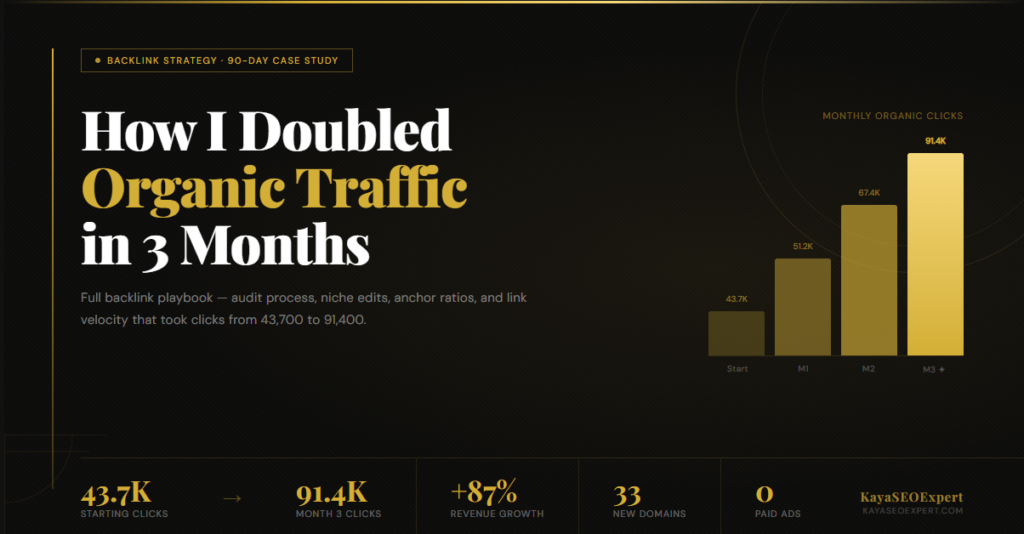
| Monthly organic clicks | 43,700 | 51,200 | 67,400 | 91,400 |
| Referring domains | 18 | 26 | 37 | 51 |
| Domain Rating | 16 | 21 | 28 | 38 |
| Keywords in top 10 | 14 | 19 | 31 | 52 |
| Revenue from organic | baseline | +18% | +41% | +87% |
The traffic didn’t double on day one. It compounded. This is the core principle behind any successful ecommerce backlink strategy 2026.
Month 1 was modest.
Month 2 showed clear momentum.
Month 3 is where the compounding effect fully kicked in.
This is how real link building works — it’s not a switch, it’s a slope.
The 3 Mistakes That Kill E-Commerce Backlink Campaigns
Before you implement this strategy, here are the three errors I see most often:
Mistake 1 — Linking only to the homepage Your homepage doesn’t sell anything. Your category and product pages do. Build links where the revenue is.
Mistake 2 — Ignoring anchor text ratios One over-optimized campaign can suppress a domain for months. Track every anchor in a spreadsheet from day one.
Mistake 3 — Expecting results in 30 days Link building is a 60-90 day process minimum. The stores that quit after month one never see the compounding effect that starts in month two.
What to Do Next
If your e-commerce store is stuck in the same position month after month despite publishing content and making on-page changes, the problem is almost certainly off-page authority.
This ecommerce backlink strategy 2026 is the exact process I used — audit first, quality filter second, niche edits third, velocity management fourth.
Start with the audit. It takes three hours and tells you everything you need to know before spending a single dollar on outreach.
If you want a custom backlink strategy built around your store’s specific niche and current authority level, visit kayaseoexpert.com — that’s exactly what I do.