Link building for local business is one of the most overlooked opportunities in SEO today.
Most local businesses focus on Google Business Profile, keyword stuffing their homepage, and hoping for the best. Meanwhile, their competitors — often with worse websites and weaker content — keep showing up on page one.
The difference almost always comes down to one thing: authority.
And authority is built through backlinks.
After working with local businesses, ecommerce stores, and agencies across 20+ countries, I’ve seen the same pattern repeat itself. The businesses that rank locally aren’t necessarily the best — they’re the ones with the strongest backlink profiles in their area.
This guide will show you exactly how to fix that.
New to backlinks? Before diving into local link building, make sure you understand the fundamentals. Check out my guide on how to build backlinks for a new website in 2026 — it covers the foundation every site needs before going local.
Why Local Businesses Struggle to Rank on Google
Before we get into the strategy, let’s be clear about why this happens.
When someone searches “plumber in Chicago” or “furniture store in Dubai,” Google doesn’t just look at your website content. It evaluates how trusted and authoritative your site is compared to every other local competitor.
That trust is measured by:
- Domain Rating (DR) — the overall authority of your website
- Referring domains — how many unique websites link to you
- Relevance — whether the sites linking to you are in your industry or location
Most local businesses have a DR under 15. Their top competitors have a DR of 30–50. That gap is why they can’t break through — no matter how much they optimize their on-page SEO.
The good news? Local link building is actually easier than national or global link building. You have a geographic advantage nobody else outside your area can replicate.
Step 1: Understand Your Local Backlink Gap
Before you build a single link, you need to know where you stand.
Here’s how to do a quick local competitor analysis in 10 minutes:
- Search Google for your main keyword — “your service + your city”
- Take the top 3 results that aren’t Google Maps or major directories
- Check their DR using Ahrefs Free Backlink Checker or Semrush
- Check how many referring domains they have
- Compare with your own site
What you’re looking for is the gap. If your competitor has DR 38 and you have DR 12, that 26-point difference explains everything.
A realistic goal: close half that gap in 90 days with a consistent link building strategy.
Step 2: Build Your Local Citation Foundation
Citations are mentions of your business name, address, and phone number (NAP) on other websites — with or without a clickable link.
For local businesses, citations are the foundation of your backlink profile. Google uses them to verify that your business is real, legitimate, and located where you say it is.
Start with these:
Tier 1 — Essential (do these first):
- Google Business Profile
- Bing Places for Business
- Apple Maps Connect
- Facebook Business Page
- LinkedIn Company Page
- Yelp (especially if you’re in the US)
Tier 2 — Industry and local directories:
- Industry-specific directories (legal, medical, real estate, auto — each has its own)
- Your local Chamber of Commerce website
- Your city’s business directory
- Local news websites that list businesses
Each of these gives you a backlink with your business name and location. This alone can move a DR 0 site to DR 8–12 within 30–45 days.
Note: If your website is brand new (DR 0), I’d recommend reading my full guide on building backlinks for a new website first. Steps 1 and 2 there — fixing your technical foundation and earning your first easy links — apply directly before you begin the local strategy below.
Step 3: Get Links From Local Websites
This is where link building for local business gives you an advantage nobody outside your city can replicate that nobody outside your city can replicate.
Local links — from websites in your geographic area — carry extra weight for local SEO because they signal to Google that your business is genuinely embedded in that community.
Here are the most effective sources:
Local News and Media Sites
Local newspapers, news blogs, and community media outlets are goldmines for local backlinks. Their DR is typically 30–60 and their links carry serious local authority.
How to get them:
- Issue a press release about something genuinely newsworthy — a new location, a milestone, a community initiative
- Offer yourself as an expert source for local stories in your industry
- Sponsor a local event and ask for a link in their coverage
Local Business Associations
Your local Chamber of Commerce, Business Improvement District, or trade associations almost always have a member directory with links. Join them.
The membership fee is often $100–300 per year. The backlink you get is worth far more than that.
Complementary Local Businesses
Think about businesses that serve the same customers as you — but aren’t direct competitors.
A plumber can get links from local real estate agents, home improvement stores, or interior designers. A restaurant can get links from local food bloggers, wedding venues, or event planners.
Reach out with a simple, honest proposal:
“I noticed we serve a lot of the same customers. I’d love to mention you on my website — would you be open to doing the same?”
Most local business owners are genuinely happy to collaborate. This costs nothing and builds real relationships.
Local Bloggers and Influencers
Every city has bloggers writing about local food, lifestyle, home, or business topics. A local “best of” article or a feature in a local blog can drive both traffic and authority.
Find them by searching: “best [your city]” “[your industry]” blog
Step 4: Sponsor Local Events and Organizations
Sponsorship links are one of the most underused local link building tactics.
Almost every local organization — charities, sports teams, school events, community festivals — has a website. When you sponsor them, they put your logo and a link on their site.
The links are typically from legitimate, local, non-commercial websites. Google values these highly because they’re not the result of outreach or payment for links — they’re natural editorial mentions.
What to look for:
- Local charity events and fundraisers
- School and university sports teams
- Community festivals and local events
- Non-profit organizations in your city
A $200 sponsorship can get you a DR 25+ backlink that stays on their site for years.
Step 5: Create Location-Specific Content
This step is what separates businesses that rank locally from those that don’t.
Most local business websites have generic content — “We are a plumbing company serving customers” — with no location-specific depth.
Creating content specifically about your city, neighborhood, or region does two things:
- It attracts natural backlinks from other local websites
- It signals to Google that you’re genuinely local — not just someone adding a city name to a template
Content ideas that work for local businesses:
- “The Complete Guide to [Your Service] in [Your City]” — a resource that becomes the go-to reference for your topic locally
- “[Your Industry] Statistics in [Your City/Region] — [Year]” — original local data
- “Best [Complementary Services] in [Your City]” — a list that other businesses will want to share
- Case studies from local clients (with their permission)
This type of content naturally attracts links from local blogs, news sites, and businesses that want to reference something specific to their city.
Step 6: Build Niche-Relevant Links Beyond Your City
Link building for local business requires more than just local links alone.
To truly compete in your market, you also need links from authoritative websites in your industry — regardless of location.
For a local business, the best national/international link sources are:
Industry blogs and publications: If you’re a dentist, getting a mention in a dental industry blog is extremely valuable. If you’re a restaurant, a food publication link carries weight.
Supplier and manufacturer websites: Many suppliers list their dealers, installers, or retailers. If you’re an authorized dealer or certified installer for a brand, ask to be listed on their website.
Guest posts on industry websites: Write a useful article for an industry publication. You get a high-authority backlink and establish yourself as an expert. (Not sure how to approach guest posting? I break down the right way to do it in my backlinks for new websites guide.)
The ratio I recommend for local businesses: aim for 60% local links and 40% industry/niche links.
Step 7: Track, Measure, and Adjust
Link building without tracking is guesswork.
These are the three numbers you should check monthly:
| Metric | Where to Check | What You Want to See |
| Domain Rating (DR) | Ahrefs or Semrush | Steady increase month over month |
| Referring Domains | Ahrefs or Semrush | Growing — not spiking and dropping |
| Local Pack Rankings | Google Search (incognito) | Moving up in your city |
A realistic progression for a local business starting from DR 10–15:
| Timeline | Expected DR | Referring Domains | Local Rankings |
| Month 1–2 | 10–18 | +5–10 new domains | Slight improvement |
| Month 3–4 | 18–28 | +15–25 new domains | Visible movement |
| Month 5–6 | 28–38 | +30–40 new domains | Page 1 for main keywords |
These numbers assume consistent effort — not a one-time burst of links.
The Mistakes That Hold Local Businesses Back
After analyzing hundreds of local SEO campaigns, the same mistakes come up again and again:
Focusing only on Google Business Profile: GBP is important, but it won’t make up for a weak backlink profile. Your website authority matters as much as your GBP for competitive keywords.
Ignoring citations: If your NAP data is inconsistent across directories — your phone number is different on Yelp vs. Google — it actively hurts your local rankings.
Building too many links too fast: 50 links in one week looks unnatural. Google expects local businesses to grow their backlink profiles gradually. Aim for 5–15 quality links per month.
Only targeting your homepage: Build links to your service pages and location pages too. If you want to rank for “dentist in Austin,” your Austin service page needs backlinks — not just your homepage.
Giving up too early: The most common reason local link building fails is stopping at month 2. Results compound. Month 1 looks like nothing. Month 6 changes everything. (This is the same lesson I cover in the new website guide — consistency is the real strategy.)
A Real Example: From Invisible to Page One
Here’s what a consistent local link building strategy looks like in practice.
This is exactly how link building for local business works when done right
A local home services business I worked with was stuck on page 4 for their main service keyword in a competitive city. They had a well-designed website, solid content, and an active GBP.
Their DR was 11. Their top competitor was DR 42.
Over 5 months, we built:
- 12 local citation links across key directories
- 8 links from local news sites and blogs
- 4 sponsorship links from local organizations
- 6 industry-relevant guest post links
- 3 links from complementary local businesses
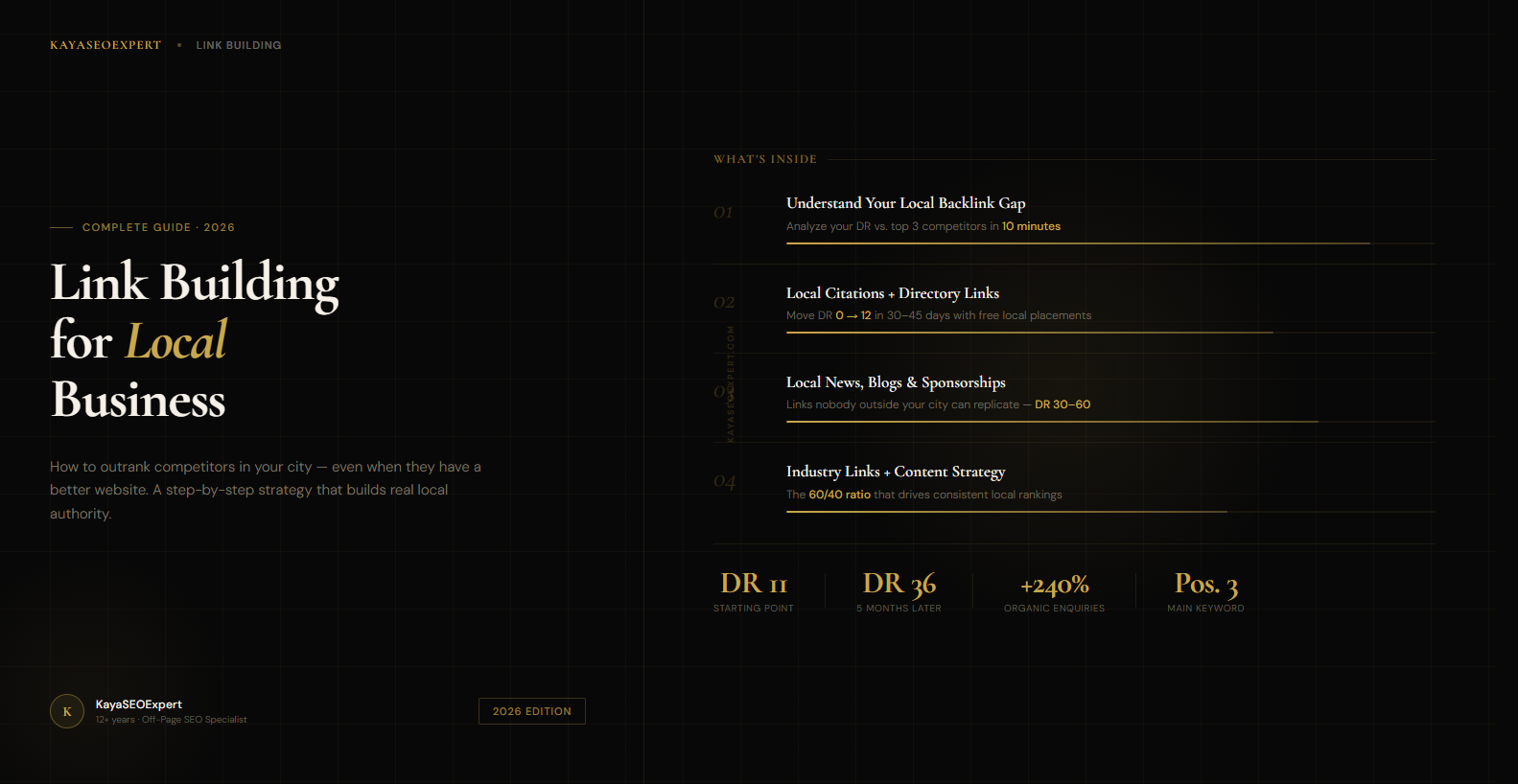
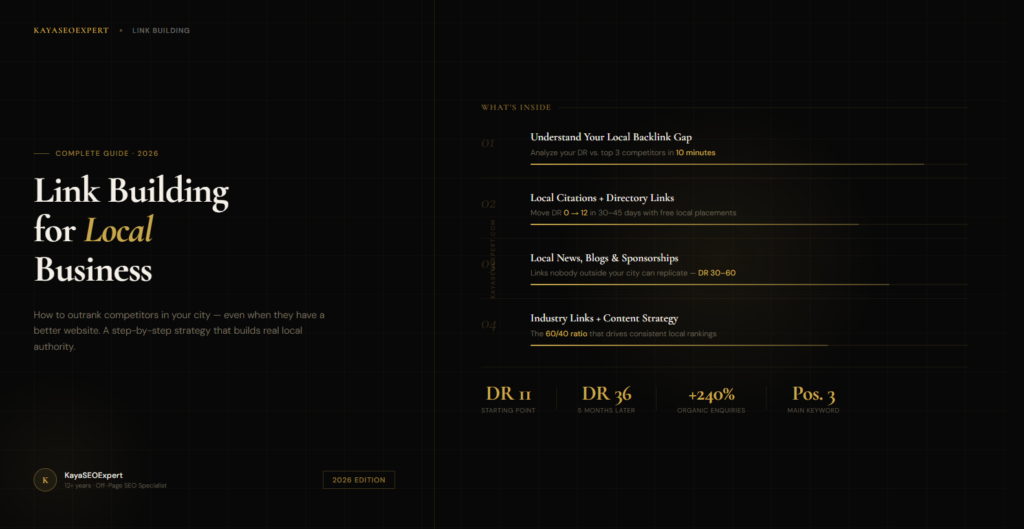
DR moved from 11 to 36. They went from page 4 to position 3 on Google for their main keyword. Organic enquiries increased by 240%.
No ads. No redesign. No new content.
Just the right backlinks, in the right order, from the right sources.
Local Link Building Strategies That Actually Work in 2026
Local link building strategies differ from general link building
in one key way: relevance. A link from a local newspaper, chamber
of commerce, or city directory carries more weight for local
rankings than a link from a global website.
The most effective local link building strategies include:
- Getting listed in local business directories
- Sponsoring local events or charities
- Building relationships with local bloggers and journalists
- Creating locally-focused content that earns natural links
What to Do Next
If you’ve read this far, you now have a complete link building for local business strategy ready to execute.
If you want to do it yourself: Start with Step 2 — build your citation foundation this week. It’s free, takes a few hours, and sets the base for everything else. If your site is new and starting from zero, my guide on how to build backlinks for a new website is the right starting point before this one.
If you want it done for you: I offer manual link building packages built specifically for local businesses and ecommerce stores. Every link is placed manually, from real websites, with full transparency.
👉 View my link building service
Want to know exactly where your local backlink profile stands before you spend a dollar?Request a free audit at kayaseoexpert.com — I’ll tell you honestly what you need.