The Moment That Decides the Fight Before It Starts
This guide breaks down law firm SEO in Saudi Arabia into a practical, step-by-step system that turns Google searches into real client inquiries — no jargon, no guesswork.
A seasoned corporate and real estate lawyer in Riyadh. Fifteen-plus years of experience. Documented results that have earned his clients’ trust, and word of mouth that still brings in a steady trickle of work — but his firm has never come close to its real potential.
One evening he opened his phone and typed into Google: “corporate lawyer in Riyadh.”
His firm wasn’t on the first page. It wasn’t on the second either.
He found competitors that had opened three years ago — smaller firms, less experienced, arguably less capable. But they were showing up, and he wasn’t.
This isn’t an exception. It’s the norm across Saudi Arabia’s legal services market today. And the reason less experienced firms outrank more experienced ones has nothing to do with Google evaluating the quality of legal work — Google can’t read a court ruling and doesn’t know who won a case.
Google measures something entirely different. That’s what this guide walks through in detail.
Section 1 — Why Google Became the Real Battlefield for Legal Competition in Saudi Arabia
The Digital Shift in How People Search for Legal Help
A decade ago, most inquiries to Saudi law firms came from two sources: personal referrals and professional relationships.
Today the landscape has changed fundamentally. More than 70% of individuals and businesses in Saudi Arabia now begin their search for a lawyer or legal advisor online — and Google specifically is the first stop.
What matters more: the person typing “law firm in Riyadh” or “corporate lawyer Saudi Arabia” into Google is at a decision point. This isn’t idle curiosity. They have a real legal problem and want a solution now.
That means every first-page appearance for these terms is a warm lead ready to engage — not a random visitor.
The Numbers Behind Saudi Arabia’s Digital Legal Market
The legal services market in Saudi Arabia is growing quickly, driven by Vision 2030 and the wave of legislative reform that has come with it. That growth has created rising demand for legal specialists in foreign investment, intellectual property, corporate law, and real estate.
The direct result: search volume for legal services on Google Saudi Arabia has climbed noticeably in recent years. Small and mid-sized companies created under Vision 2030 need legal counsel. Foreign investors entering the Saudi market are searching for trustworthy law firms. Individuals dealing with labor, family, and real estate matters turn to Google before anywhere else.
That rising demand goes to firms that show up on Google — not to firms that assume word of mouth alone is enough in 2026.
The Difference Between Appearing and Leading
Not every Google appearance translates into results. Research consistently shows that more than 70% of clicks go to the top three organic results. The tenth result on page one gets a click-through rate of barely 2-3%.
That means simply appearing on page one isn’t enough — leading the page is the actual goal. The gap between a firm in position one and a firm in position seventeen is enormous in terms of inquiry volume and client flow.
Firms that understand this and invest in their digital visibility build a real, durable competitive advantage — because competition for these positions is still limited compared to what’s coming.
Section 2 — How Google Evaluates Law Firm SEO in Saudi Arabia
What Local Search Ranking Actually Measures
When Google ranks a law firm in local search results, it weighs three main factors:
Relevance — does your website’s content and business information match what the searcher is looking for? If someone searches “commercial lawyer in Riyadh” and your site clearly covers commercial law and clearly names Riyadh, that’s relevance.
Distance — how close your office is to the person searching. This is largely outside your control, but it underscores the importance of setting your location accurately on Google.
Prominence — the most important factor, and the most within your power to influence. Prominence in Google’s terms doesn’t mean your actual reputation in the legal market — it means how much the internet as a whole vouches for you. It’s measured through three things:
- The number and quality of external sites linking to your website
- The number, recency, and quality of your Google reviews
- The consistency of your information and presence across the web
Google Business Profile: The Infrastructure of Local Visibility
Law firms that lead search results in Riyadh, Jeddah, and Dammam share one trait: a complete, current, and active Google Business Profile.
Complete means:
- Full, accurate firm name
- Correct address including district and area
- Precise business hours, including holidays and seasonal changes
- Updated phone number
- Website link
- A description covering your specialties and the areas you serve
- The right primary category (“Law Firm” or “Lawyer”) plus relevant secondary categories
- Clearly listed services
- Photos of the office, team, and logo
Active means:
- Regular posts
- Answering visitor questions
- Responding to reviews — both positive and negative
- Adding fresh photos periodically
Google can tell the difference between a living profile and a dead one — and it rewards the living one with better positions.
Reviews: The Overlooked Advantage
Reviews matter more in legal services than in almost any other category, for a simple reason: someone searching for a lawyer is making a decision that affects their business, property, or freedom — and they want every bit of reassurance available before they call.
Reviews work on two levels:
- Ranking: Google favors firms with more, fresher, and higher reviews with better positions.
- Conversion: a visitor who finds your firm and reads several recent positive reviews is far more likely to call.
Smart firms build a system for requesting reviews — never in a way that violates Google’s policies, but by simply guiding satisfied clients to share their experience once a matter concludes successfully.
Equally important: responding to reviews. A thoughtful reply to a positive review that references the service and case type adds relevant content to your profile and shows both Google and future clients that your firm is present and engaged.
Your Website: The Technical Foundation for Organic Search
While your Google Business Profile drives visibility in Maps results, your website is what places you in organic search results — the listings below the map that span multiple pages.
A law firm website aiming to lead local search needs:
Dedicated service pages — every legal specialty you offer deserves its own page: corporate law, real estate matters, labor law, family law. These are the pages that surface when someone searches “real estate lawyer in Riyadh.”
Geographic pages — if you serve Riyadh, Jeddah, and Dammam, each city deserves its own page — not a copy-paste, but a page that speaks to local courts, local regulations, and your specific experience in that area.
Educational legal content — articles that answer common questions people actually search for: “How do I register a company in Saudi Arabia?” “What are my rights in a wrongful termination case?” These articles bring in visitors during their research phase and then convert them into clients.
Structured schema data — technical code added to your site that tells Google explicitly: this is a law firm, located here, specializing in these areas, serving these regions. It helps Google understand your site faster and more accurately.
Section 3 — The Authority Gap: The Hidden Reason Your Competitors Outrank You
What Is the Digital Authority Gap?
Imagine Google asking the entire internet: “Who vouches for this firm?”
Every site that publishes a link pointing to yours is essentially telling Google: “I vouch for this firm.” The more trustworthy and relevant the vouching site is to the legal field, the heavier that vouch weighs.
This is what’s known as Domain Rating (DR) — a measure of how much the internet trusts your website, based on the quantity and quality of links pointing to it.
The authority gap is the difference between your site’s DR and the DR of the competitors currently outranking you.
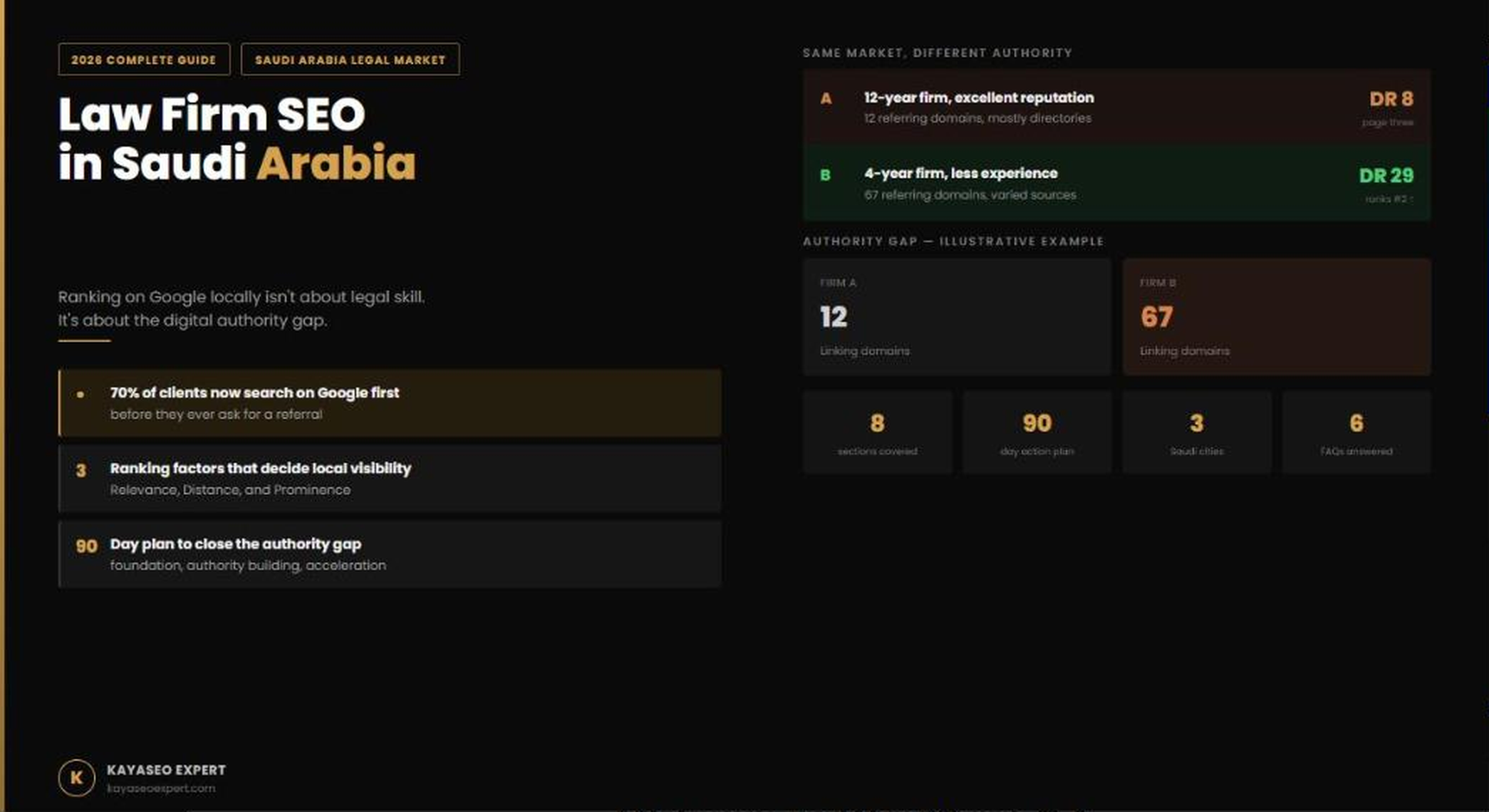
A Real Example From the Saudi Legal Market
Let’s take a realistic scenario — a Riyadh law firm trying to lead the term “corporate lawyer Riyadh.”
Firm A — 12 years old, excellent reputation, documented experience:
- Website DR: 8
- Sites linking to it: 12
- Mostly: a Saudi lawyers’ directory and a page on one legal platform
Firm B — 4 years old, less experienced:
- Website DR: 29
- Sites linking to it: 67
- Varied: a legal magazine, a Saudi business site, a business association, a professional organization, a legal blog
The search result? Firm B ranks second. Firm A is on page three.
Not because Firm B is legally better. Because it’s digitally stronger.
(This is an illustrative, hypothetical scenario — not a claimed real client result — used only to demonstrate how the authority gap works.)
Why the Gap Widens Over Time
The deeper problem: competitors building their digital links now extend their lead every month. Every link they earn widens the gap between you and them.
A year from now, if you haven’t started, you’ll need significantly more effort to close the distance.
Time in SEO compounds — much like early investing. Starting today is worth roughly double starting six months from now.
Section 4 — A Practical 90-Day Plan to Lead Google for Your Law Firm
Month One (Days 1-30): Building the Foundation
Week 1 — The Full Audit
Before anything else, you need a clear picture of where you stand.
Search Google for the terms you should be ranking for: “law firm Riyadh,” “corporate lawyer Saudi Arabia,” “real estate lawyer Riyadh.” Note where your site appears — if it appears at all.
Open Google Search Console and check: is your site indexed? Are there technical errors? Are there terms you rank for, but only in low positions?
Open your Google Business Profile and honestly assess its completeness — is every field filled in? Are the photos current? When was your last review?
Week 2 — Fixing the Foundation
Complete every field in your Google Business Profile. Don’t leave anything blank. Write a description that names your legal specialties and the areas you serve.
Add current, professional photos: the office exterior and interior, the legal team, the firm’s logo, images that convey professionalism.
Review your website: does every service page naturally mention Riyadh or your operating city in the title and content?
Week 3 — Targeted Content
Write a legal article answering a common question in your field. “What are the legal steps to establish an LLC in Saudi Arabia?” or “What are an employee’s rights in a wrongful termination case?”
This content works on two levels: it attracts visitors searching for that information, and it signals to Google that you’re an authority in your field.
Week 4 — Starting Link Building
Start with the easy links first:
- Ask any professional association or business union you belong to add a link to your site on their members page
- If you’re listed in any local lawyer directory, confirm your link is present and current
- If you’ve spoken at or attended legal conferences or events, reach out to the organizers about a link on their speakers or participants page
For a full walkthrough on starting link building for a new site, see our guide, How to Build Backlinks for a New Website.
Month Two (Days 31-60): Building Authority
This month is the core of the whole plan — because it addresses the digital authority gap separating you from page one.
Guest posts on legal and business sites
Look for sites and blogs covering:
- Saudi business and economics
- Entrepreneurship and startups
- Law and regulation in the Kingdom
- Investment and real estate
Reach out and propose a guest article that offers real value to their audience — with a natural link back to your site or a specific service page.
New corporate law, foreign investment regulations, labor law amendments — these are all substantive topics for these audiences, and you’re qualified to write about them credibly.
Niche edits in existing articles
This is faster than guest posts. Find existing articles about law or business in Saudi Arabia and reach out to the authors about adding a link to your site in a natural spot within the existing piece.
An article about “steps to establish a company in Saudi Arabia” could naturally include a line like: “It’s always recommended to work with a specialized corporate law firm such as…” — and that’s where your link goes.
Building relationships with chambers of commerce and professional bodies
Chambers of commerce in Riyadh, Jeddah, and Dammam run high-authority websites with a natural connection to legal services. Being an active member and offering lectures or seminars opens the door to links from these sites — among the most valuable links in a local Saudi context.
Goal for month two: 8-12 links from relevant sites.
Month Three (Days 61-90): Acceleration and Measurement
Intensify link building
By month three, you have a foundation to build on. It’s time to get targeted.
Research your top-ranking competitors and see where their links come from. Use Ahrefs or Semrush to see the list of sites linking to them — then target those same sites.
If a Saudi legal or media site links to your competitor, your odds of landing on that same site are real and achievable.
Raising your site’s DR
Building sustainable domain authority is a systematic process, not artificial link schemes that violate Google’s policies. For related local-authority tactics, see Local Link Building: The Complete Guide for Local Businesses.
Measuring progress
At the end of month three, return to Google Search Console and compare:
- Where were you in month one?
- Where are you now?
- How many new keywords entered page one?
- How much organic traffic increased?
Realistic expected outcomes at 90 days:
- DR: moving from roughly 5-10 to 15-20 (depending on effort invested)
- Rankings: clear improvement on competitive local terms
- Organic traffic: a meaningful increase, magnitude depending on starting point and effort
- New inquiries from Google: noticeable in the final weeks of this period
(These are directional expectations based on general SEO patterns, not a guaranteed or specific numeric promise for any individual firm.)
Section 5 — The Golden Keywords for Saudi Law Firms
Tier One — High-Competition Terms (For Later)
These are large terms that require high DR to compete for:
- Lawyer Saudi Arabia
- Law firm
- Best lawyer
Don’t target these yet — go after them once your site’s DR is above 35.
Tier Two — Balanced Terms (Start Here)
| Keyword | Why Target It |
|---|---|
| Law firm in Riyadh | Local + contract intent |
| Corporate lawyer Riyadh | Specialized + commercial |
| Real estate lawyer Saudi Arabia | High demand + purchase intent |
| Legal consultant Riyadh | Corporate audience |
| Labor dispute lawyer | Good search volume |
Tier Three — Long-Tail Terms (Start Immediately)
These are your real gold in the early stage:
| Keyword | Why It’s Golden |
|---|---|
| How to register a company in Riyadh | High search intent + near-term decision |
| Company formation lawyer Riyadh | Very specific + contract-ready |
| Employee rights in wrongful termination | Urgent problem + wants a lawyer |
| Lease contract lawyer Saudi Arabia | Sub-niche + real demand |
| Corporate law firm specializing in startups Riyadh | Long-tail + clear contract intent |
Section 6 — Common Mistakes Saudi Law Firms Make
Mistake One — Relying Entirely on Word of Mouth
Word of mouth is valuable, no argument there. But it can’t keep pace with the rising demand created by Vision 2030 and the economic expansion that followed. New individuals and companies entering the market don’t know you — they find you through Google.
Relying on word of mouth alone means losing a large slice of potential clients every day.
Mistake Two — A Beautiful Website With No Content
Many Saudi law firms invest in a lavish website design — then leave it untouched for years. A good-looking site with no search-optimized content is invisible to Google.
Design convinces a visitor after they arrive — but content is what brings the visitor in the first place.
Mistake Three — Neglecting Reviews
Firms that don’t ask satisfied clients to leave a Google review are leaving a massive competitive advantage on the table.
Do you ask the client whose case you won successfully for a review? Most firms don’t. That neglect keeps them behind competitors who may be less capable but have far more reviews.
Mistake Four — Generic Keywords Instead of Local Ones
A Riyadh firm targeting the generic word “lawyer” puts itself in competition with every law firm in the Kingdom. Meanwhile, “corporate lawyer Riyadh” puts you in competition with only a few dozen firms — while reaching the same audience.
Geographic and specialty focus in your target keywords maximizes your odds given your current resources.
Mistake Five — Buying Cheap Links
This is the most damaging mistake. Buying link packages from unknown or weakly related sites doesn’t improve your ranking — it puts you at real risk of a Google penalty that could remove you from search results entirely.
Google tightened enforcement against artificial link patterns significantly in 2024-2025. Good links — from genuinely relevant sites with real content — are the only kind that build sustainable authority.
Mistake Six — Not Measuring Results
“We’re on Google” isn’t a metric. The positions you rank in, the organic visits you get, the inquiries coming from Google — these are the numbers that tell you whether your efforts are working.
Without measurement, you can’t know what’s working and what isn’t, and you keep wasting time and money without a clear result.
Section 7 — Competitive Analysis: What Top-Ranking Firms in the Saudi Legal Market Do
One Pattern Repeats in Every Success Story
After analyzing dozens of law firm websites leading search in Riyadh, Jeddah, and Dammam, the pattern is clear.
Top-ranking firms:
- Publish regular educational legal content (not just an “About” page and a services page)
- Keep their Google Business Profile updated weekly
- Have links from economic media outlets and professional organizations
- Have pages optimized for specific local terms (Riyadh, Al Olaya district, King Fahd Road)
- Respond quickly to inquiries — even those coming directly through Google
Non-ranking firms:
- A stagnant site with no content added in months or years
- A partially completed or neglected Google Business Profile
- Little to no external links
- No local keywords on their pages
- No system for requesting reviews
The difference isn’t firm size, history, or the quality of legal service. The difference is systematic digital investment.
Outmaneuvering the Leaders Instead of Copying Them
Instead of trying to do exactly what the current leader does, think about what they’re not doing.
If the Riyadh leader has no content targeting Jeddah — that’s your opening in Jeddah.
If the corporate law leader has no content about startups — target that niche.
Specializing within your specialty is the fastest path to leading a competitive market.
Section 8 — Free Tools to Start With Today
Google Business Profile Manager — the most important tool in your arsenal. Open business.google.com and review every detail of your profile.
Google Search Console — a free tool straight from Google. Shows you the terms your site appears for, its positions, click counts, and the technical issues blocking indexing. You’ll need to connect it to your site if you haven’t already — a simple technical step that unlocks valuable data.
Ahrefs Free Backlink Checker — a partially free tool that lets you check your site’s DR and your competitors’ DR, along with the number of links pointing to each site. These numbers are what you need to measure the authority gap between you and the leaders.
Google Keyword Planner — a free tool for finding monthly search volume on the keywords you’re targeting. Helps you prioritize — target terms with sufficient search volume before rare ones.
Conclusion — Today’s Decision Shapes Tomorrow’s Position
Back to the question that opened this guide: why does a smaller, less experienced firm outrank yours on Google?
Now you know the answer. And you know what you need to do.
The good news: the Saudi legal market is still in its early digital stages. Competition for legal search terms on Google is far lower than in comparable Western markets. Whoever starts now builds an advantage that will be hard for latecomers to close.
The other piece of news: this isn’t magic, and it isn’t complex technology. It’s a clear, executable methodology that requires patience rather than speed — because Google’s results accumulate rather than arrive all at once.
Every week that passes without digital work is a week your competitors gain ground. Every week of systematic work is an investment that pays off for months and years to come.
If you’d like a personalized assessment of your firm’s current standing — and a clear roadmap for exactly what you need to lead your target keywords — get in touch at kayaseoexpert.com and we’ll build your plan based on the real, current state of your site and your competitors.
Frequently Asked Questions From Law Firm Owners
How long does it take to reach page one?
This question deserves an honest answer, not a flattering one.
For low-competition terms like specific long-tail keywords: you can see noticeable improvement within 6-10 weeks of a systematic start.
For medium-competition terms like “corporate lawyer Riyadh”: 3-6 months of sustained work to reach page one.
For high-competition terms like “law firm”: 6-12 months or more, and you’ll need a high DR to compete.
The number isn’t fixed — it depends on your current standing, competition intensity, how systematic your execution is, and how much you invest in link building.
But the constant rule holds: whoever starts today will be in a better position in six months than whoever starts six months from now.
Do I need a specialized agency, or can I do this myself?
It depends on your resources and time.
What you can do yourself: completing your Google Business Profile, writing legal content in your area of expertise, requesting reviews from clients, and regularly checking Search Console.
What needs specialized expertise: external link building, technical site setup (schema markup, load speed, page structure), and competitor analysis.
The ideal mix: you produce the legal content with your expertise, and an SEO specialist handles the technical side and link building.
Are positive reviews enough on their own?
Reviews matter a great deal, but they’re one piece of a bigger picture. A firm with 50 reviews at 4.8 stars but zero site DR and an incomplete Google Business Profile will lose out to a firm with 20 reviews at 4.5 stars but strong links and an optimized site.
Reviews improve your visibility and improve visitor-to-client conversion — but they don’t compensate for weak digital authority.
The right strategy: work on every factor at once, don’t put all your effort into reviews alone.
What if my area is extremely competitive?
If core terms like “law firm Riyadh” feel out of reach right now — the answer is deeper specialization.
“Small business formation lawyer in Al Olaya, Riyadh” is far more attainable than “lawyer in Riyadh.” Once you lead the more specific terms and build your authority through them, you can later expand toward the broader terms.
Double specialization — geographic and practice-area — is the path that puts early adopters ahead of competitors who tried to lead everything at once.
Does my presence on LinkedIn and Twitter affect my Google ranking?
Directly: no. Google doesn’t award extra points for how often you post on social media.
Indirectly: yes, but in a specific way. Your LinkedIn activity can:
- Bring natural links from sites that mention or share your articles
- Increase direct searches for your firm’s name
- Build professional relationships that lead to partnerships and shared content that generates links
Use LinkedIn to build professional relationships and credibility — as a complement to SEO, not a substitute for it.
What to Do Next Week
If you take away one decision from this guide, let it be this: start this week.
Not next week. Not after the current caseload clears. This week.
This coming week:
- Open your Google Business Profile and fill in every empty field
- Search your firm’s name on Google and note where it currently appears
- Open Google Search Console if it isn’t already connected
- Reach out to a satisfied client and ask for an honest review
These four steps cost nothing, and everything after builds on them.
The distance between a firm that doesn’t appear on Google and one that leads its local keywords isn’t a distance of legal talent — it’s a distance of digital decision-making. And now you know the path.
Want this done for your site?
All links are placed manually — white-hat, no spam. See Monthly SEO Packages or Arabic Guest Posts, or place an order.